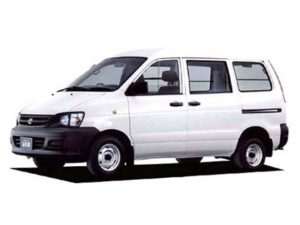
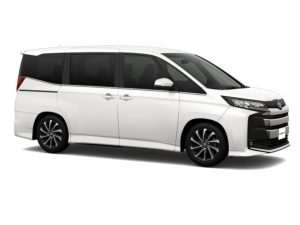
The KR42's greatest trick is not its engine. It is the amount of human being it can transport.
The cabin was designed around a flat-floor MPV concept, with three seating rows and walk-through access in the passenger-oriented Noah versions. Toyota's historical documentation describes the Noah family as offering six, seven or eight passenger configurations depending on specification.
In Bangladesh, the eight-seat configuration is the one people generally associate with the KR42. That makes it particularly useful for large families, school transport, small businesses and occasional group travel.
The dashboard is extremely simple by modern standards. There is no giant central screen, no digital assistant waiting to misunderstand you and certainly no touchscreen telling you that your climate-control settings have been moved into a submenu.
That simplicity is actually useful. Controls are straightforward and repairs are generally easier than with a modern electronically packed MPV.
Comfort depends heavily on the individual vehicle. A well-maintained KR42 can still have a surprisingly comfortable ride, but worn suspension bushes, tired seats, weak AC and aging door mechanisms are common concerns simply because these vehicles are old.
Bangladesh-market cars often receive aftermarket multimedia systems, reverse cameras, upgraded speakers, leather seat covers and additional CNG equipment. Some of these modifications are useful; others have the engineering elegance of a roadside science experiment.
For family use, the cabin's space remains its strongest argument. It is old, basic and practical — which is exactly why people still buy it.