4.0 Expert Rating

Toyota Yaris 2nd Gen (2005-2011) Expert Review

Extensively tested and reviewed by Team CarHub

EXPERT VERDICT
"
Toyota Yaris is a compact, reliable and economical hatchback that suits Bangladesh's crowded city roads and everyday commuting extremely well.
AT A GLANCE

Pros & Cons

✓
WHAT WE LIKE

Good Things

  • ✓
    Excellent city maneuverability
  • ✓
    Strong fuel economy
  • ✓
    Reliable Toyota engine
  • ✓
    Easy parking
−
WHAT COULD BE BETTER

Could Be Better

  • −
    Limited cabin space
  • −
    Low ground clearance
  • −
    Basic interior
  • −
    Weak acceleration
Toyota Yaris 2nd Gen (2005-2011)
— 47 Reviews
৳ 6.00 Lakh - 15.00 Lakh

Exterior

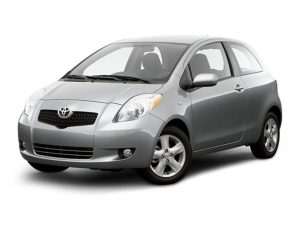
The Toyota Yaris of this generation is the automotive equivalent of someone who owns sensible shoes but secretly listens to loud music. It is small, practical and thoroughly Japanese, yet there is enough styling to stop it looking like a kitchen appliance.

The second-generation Yaris/Vitz introduced a rounded, cab-forward design that maximised interior space without turning the car into a tiny van. The short bonnet, tall cabin and relatively upright rear make the car look compact from every angle, which is exactly what you want when negotiating Dhaka's crowded streets.

At roughly 3.8 metres long and 1.7 metres wide, it is considerably easier to position than most family sedans. The short overhangs also make the corners easy to judge. This becomes particularly useful when squeezing through narrow lanes or trying to park beside a busy Bangladeshi market where apparently everyone has decided that the road is actually a parking lot.

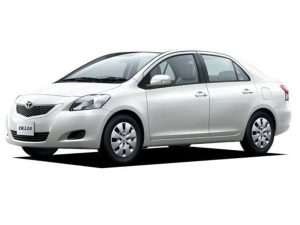
The later facelift models received sharper exterior detailing and improved lighting equipment depending on grade. Sportier RS versions look noticeably more aggressive, while F versions remain deliberately conservative.

The biggest exterior weakness for Bangladesh is ground clearance. The car's low stance looks good, but large speed breakers and deep potholes demand patience. The standard 165/70R14 tyres provide a useful amount of sidewall for urban roads and are relatively easy to source.

Overall, the Yaris is not beautiful in the traditional sense. It is cleverly proportioned, friendly-looking and extremely easy to live with.

Interior

The Yaris interior follows the classic Toyota philosophy of the period: everything is where you expect it to be, and very little is trying to impress you. The dashboard is simple and functional, with an uncluttered arrangement of controls. Depending on grade and year, equipment varies considerably, but the basic cabin prioritises practicality rather than luxury. Hard plastics dominate, although they are generally durable enough to survive years of ordinary family use. The clever part is the packaging. Despite its small exterior dimensions, Toyota created a surprisingly useful cabin. The tall roof gives good headroom, while the flexible rear-seat arrangement allows you to prioritise passengers or luggage. The rear seats can fold to increase cargo capacity when you need to carry larger items. For Bangladesh, the compact dimensions are a genuine advantage. The Yaris feels easy to place on narrow Dhaka roads, and the relatively upright seating position gives you a useful view of surrounding traffic. The air-conditioning is particularly important in Bangladesh's climate, although older examples should have their AC system inspected carefully. The limitations become obvious when five adults travel together. Rear-seat space is adequate rather than luxurious, and luggage capacity is modest compared with a sedan or MPV. There is also very little modern connectivity in the original car. Bluetooth, smartphone mirroring, USB charging and touchscreen entertainment are largely aftermarket territory. But that simplicity has one advantage: fewer complicated electronic toys to break.

Features

Yaris was never designed to win a technology competition. Instead, it offered the practical equipment people actually used every day.

Depending on grade, features included power windows, central locking, air-conditioning, adjustable steering, keyless entry, foldable rear seats, privacy glass, UV-cut glass, cup holders and accessory power. Higher grades such as the U added more sophisticated convenience equipment, including Toyota's Smart Entry and Start System. Toyota's catalogue also lists the F, U, RS, I'll and several special-edition versions across this generation.

The representative 1.3 F is relatively basic. It has manual air-conditioning, power windows and central locking, while factory navigation, xenon headlights and other premium equipment were optional or grade-dependent. Toyota's 2009 F specification confirms standard power windows, central locking, ABS, airbags, Brake Assist, EBD and split-folding rear seats.

For a modern Bangladesh owner, the most noticeable omission is smartphone connectivity. There is no factory Apple CarPlay or Android Auto in this configuration, and Bluetooth is not part of the original basic setup.

Fortunately, this is one of the easiest cars to modernise. A quality aftermarket touchscreen with Bluetooth, reverse camera and Android Auto can transform the user experience without fundamentally changing the car.

The Yaris therefore has a useful combination: simple original equipment and plenty of scope for inexpensive modern upgrades.

Safety

Yaris has a safety package that was respectable for its era, although modern cars have moved considerably further.

The representative 2009–2010 1.3 F includes driver and passenger airbags, side airbags, ABS, Brake Assist, EBD, front seatbelt pretensioners, front seatbelt force limiters, three-point rear seatbelts and child-seat attachment provisions. Toyota also lists a reinforced safety body and side-impact protection.

That is important because the Yaris is a small hatchback. Its compact dimensions and low weight make modern safety equipment particularly valuable when sharing roads with larger vehicles, buses and trucks.

However, there is no modern Toyota Safety Sense-style system here. You do not get autonomous emergency braking, forward collision warning, lane departure warning, lane keeping assistance, adaptive cruise control or blind-spot monitoring. Those technologies simply belong to a much newer generation.

For real Bangladesh driving, the condition of the individual vehicle matters enormously. A Yaris with properly functioning ABS, good tyres, healthy brakes and an undamaged body is a very different proposition from one that has suffered a serious accident and been poorly repaired.

The factory safety package therefore deserves credit for what it offered when new, but you should judge a 2005–2011 Yaris as an older vehicle rather than expecting contemporary driver-assistance technology.

Its strongest safety feature today may simply be its predictable handling and easy manoeuvrability.

Driving Experience

Driving the Yaris is a reminder that not every car needs to be fast to be enjoyable. The 1.3L 2SZ-FE produces 87 hp and 116 Nm, which sounds modest because it is modest. But the car weighs only around a tonne, so the engine has far less mass to haul around than a typical modern SUV. Around town, it feels responsive enough and the CVT keeps progress smooth. The steering is light, the turning circle is excellent and the compact body makes the car extremely easy to place. In Dhaka traffic, these characteristics are more useful than another 100 horsepower. When a CNG auto-rickshaw suddenly appears where no object should logically be, the Yaris can change direction and squeeze through gaps without requiring the captaincy skills of a rally driver. Bangladesh mileage is naturally lower than Toyota's Japanese laboratory figures. Expect roughly 12–13 km/L in heavy city use, 16–18 km/L on open highways and around 14–15 km/L combined when the car is healthy and driven sensibly. Long-distance driving is comfortable enough, although the small cabin and modest engine become more obvious with five adults and luggage. The suspension handles normal roads well but the low clearance requires care around large speed breakers. The Yaris is therefore not a performance car. It is something arguably more valuable: a small automatic that makes everyday driving easy, inexpensive and pleasantly undramatic.
EXPLORE THE RANGE

Variants

The 2005–2011 Yaris/Vitz period covers a surprisingly large number of configurations. Toyota offered 1.0L, 1.3L and 1.5L engines, with FWD as the mainstream layout and 4WD available on selected 1.3L versions. The catalogue included F, U, RS, I'll and several special editions. The 1.0L models are focused heavily on economy and urban use. They are adequate for commuting but feel less relaxed when carrying passengers or travelling at highway speeds. The 1.3L F is the sensible middle ground. It provides enough performance for Bangladesh's normal city and highway driving while retaining the economy that makes the Yaris attractive. The U adds comfort and convenience equipment, including Smart Entry and Start System on applicable versions. The RS is the enthusiast-flavoured version. It brings sportier styling and a more youthful character, while 1.5L versions provide stronger performance for drivers who find the 1.3L too restrained. For Bangladesh, the exact grade matters less than the condition of the individual car. A clean 1.3L with a healthy CVT, good suspension and proper maintenance is generally more useful than a high-grade example that has been neglected. The Yaris's greatest strength is therefore its simplicity. It is small enough for Dhaka, economical enough for everyday use, mechanically familiar enough for local workshops and easy enough to park almost anywhere. It is not a glamorous car. It is a very good tool. And sometimes, that is precisely the point.
TRENDING

Trending Toyota Cars

View All Toyota Cars
FAQ

Toyota Yaris 2nd Gen (2005-2011) Questions & Answers

Toyota Yaris, commonly known as Toyota Vitz in Bangladesh, currently starts from around Tk 6 lakh for older models and can reach approximately Tk 15 lakh for newer cars or higher-grade versions.

View All Toyota Yaris 2nd Gen (2005-2011) FAQs
📍

Find Dealers Near You

Looking for Toyota Yaris 2nd Gen (2005-2011) ? We will notify you when verified dealers become available.

💳

Calculate Your Car EMI

Estimate your monthly payment for Toyota Yaris 2nd Gen (2005-2011)

৳ 30,00,000
৳5L ৳1Cr
৳ 5,00,000
৳0 ৳30L
9%
5% 18%
5 Years
1 Year 7 Years
Your Monthly EMI ৳ 64,250 Estimated payment per month
Principal Amount ৳ 30,00,000
Total Interest ৳ 7,68,000
Total Payment ৳ 37,68,000