5.0 Expert Rating

Toyota Wish 1st Gen (2003-2009) Expert Review

Extensively tested and reviewed by Team CarHub

EXPERT VERDICT
"
Toyota Wish is a practical seven-seat MPV with strong reliability, useful space and affordable ownership for Bangladesh family driving.
AT A GLANCE

Pros & Cons

✓
WHAT WE LIKE

Good Things

  • ✓
    Spacious seven-seat cabin
  • ✓
    Reliable 1.8L engine
  • ✓
    Comfortable family transport
  • ✓
    Good parts availability
−
WHAT COULD BE BETTER

Could Be Better

  • −
    Low ground clearance
  • −
    Older safety technology
  • −
    Basic interior materials
  • −
    Modest acceleration fully loaded
Toyota Wish 1st Gen (2003-2009)
— 42 Reviews
৳ 10.00 Lakh - 18.00 Lakh

Exterior

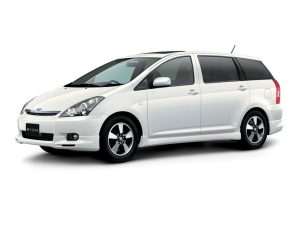
The first-generation Toyota Wish has aged surprisingly well. It was designed in an era when Toyota discovered that a family MPV did not necessarily need to look like a bread van, and the result is a fairly sleek, low-slung seven-seater.

The body is relatively compact at around 4.56 metres long, which is useful in Bangladesh. It gives you three rows without becoming a nightmare to manoeuvre through Dhaka streets. The relatively low roofline also gives the Wish a more car-like appearance than taller MPVs such as the Noah or Voxy.

The 2005 facelift sharpened the front grille, headlights and rear lighting, giving the later first-generation models a noticeably fresher appearance. Toyota also fitted redesigned wheel covers and updated exterior details.

The side profile is probably the strongest part of the design. It has a long glasshouse, clean shoulder line and enough visual movement to avoid looking like a delivery vehicle.

There is one obvious Bangladesh problem: ground clearance. The Wish sits fairly close to the road, so large speed breakers and deep potholes need respect. The upside is that its lower centre of gravity contributes to more stable handling than taller MPVs.

It is not going to turn heads like a Supra, but for a family car from the early 2000s, the Wish has aged rather gracefully.

Interior

Wish interior is where Toyota's practical thinking becomes obvious. Rather than building an enormous dashboard and wasting space, Toyota created a relatively simple cabin with three rows of seats and numerous storage areas.

The seven-seat layout is the main attraction. The second row can accommodate three people, while the third row provides additional seating when required. Fold the rear seats and the cabin becomes significantly more useful for luggage, shopping or household cargo.

The driving position is fairly car-like, which makes the Wish less intimidating than some larger MPVs. Visibility is good, and Toyota specifically improved forward and rearward visibility through the facelift design.

The materials are understandably dated now. Hard plastics dominate, the instrumentation is analogue and the infotainment system belongs firmly to another technological century. But the controls are simple and easy to understand.

For Bangladesh, the cabin's biggest strength is practicality. Seven seats are useful for larger families, and the relatively narrow body makes the car manageable on urban roads.

The biggest weakness is third-row space. Adults can use it, but long journeys with seven adults will not feel luxurious.

Still, if you judge the Wish as an affordable family MPV rather than a modern luxury vehicle, the interior remains impressively functional.

Features

Toyota Wish was well equipped for its time, although modern expectations make the equipment look rather modest today.

The 1.8 X provides useful basics such as full automatic air-conditioning, power windows, central locking, tilt steering, folding rear seats, UV-cut glass and privacy glass. Toyota's official equipment list confirms these features on the facelift X grade.

Safety equipment includes ABS, Brake Assist, EBD, dual front airbags, three-point rear seat belts and child-seat mounting provisions. That was a respectable package for the period.

Higher grades added more interesting equipment. The X Aero Sports Package brought standard front fog lamps, HID headlights, leather-wrapped steering wheel, 15-inch alloy wheels and additional exterior styling. The Z went further with its 2.0-litre engine, traction control and larger 17-inch wheels.

Today, however, the Wish is obviously missing modern technology. There is no factory Apple CarPlay, Android Auto, advanced driver assistance or modern touchscreen infotainment on the standard configuration.

Fortunately, aftermarket Android head units, reverse cameras, parking sensors and Bluetooth systems are easy ways to modernise the cabin.

The Wish's real feature is therefore not a touchscreen. It is the combination of seven seats, automatic AC, flexible seating and simple Toyota engineering.

Safety

For a car designed in the early 2000s, the first-generation Wish has a reasonable basic safety package. The standard 1.8 X includes driver and passenger airbags, ABS, Brake Assist, EBD, front seatbelt pretensioners, rear three-point seatbelts, child-seat mounting provisions and side-impact protection. That equipment provides a useful foundation, but expectations need to remain realistic. This is an old MPV and does not have the electronic safety technology found in modern Toyota models. There is no Toyota Safety Sense, autonomous emergency braking, lane-keeping assistance, adaptive cruise control, blind-spot monitoring or automatic high-beam assistance on the representative 1.8 X. Some higher grades could be equipped with side airbags, but they were not standard on the X grade. The Wish's lower body and relatively low centre of gravity provide stable road manners, while the wide windscreen and good visibility make everyday driving easier. For Bangladesh, the condition of an individual vehicle is extremely important. A 20-year-old MPV with worn tyres, damaged suspension, poorly repaired accident damage or non-functioning airbags is obviously a different proposition from a properly maintained example. So the Wish offers respectable period safety, but it should not be compared directly with a modern Voxy or Corolla Cross equipped with contemporary driver assistance.

Driving Experience

The Wish drives more like a large hatchback than a traditional tall MPV, and that is one of its greatest charms. The 1.8-litre 1ZZ-FE produces 132 PS and 170 Nm, giving the seven-seat Wish enough power for normal city driving and highway cruising. It is not particularly quick, especially with seven people aboard, but the engine is smooth and predictable. The four-speed automatic in the representative 1.8 X is old-fashioned by modern standards. There is no clever eight-speed gearbox or hybrid assistance. You select D, press the accelerator and the car gets on with it. In Dhaka traffic, the automatic transmission and relatively compact body make the Wish easy to drive. The steering is light, visibility is good and the 5.3-metre turning radius is reasonable. Toyota also designed the cabin with improved visibility around the A-pillars and rear section. On highways, the Wish is comfortable at normal cruising speeds. The lower body gives it more stable handling than taller MPVs, although overtaking fully loaded requires some planning. Fuel economy is acceptable rather than spectacular. Expect roughly 8–9 km/L in heavy city traffic and around 12–14 km/L on open highways when the vehicle is healthy. The biggest Bangladesh complaint is ground clearance. Speed breakers must be approached carefully. Overall, the Wish is a pleasantly simple family car: easy to drive, predictable and genuinely practical.
EXPLORE THE RANGE

Variants

first-generation Toyota Wish had a surprisingly broad range. The main 1.8-litre versions included X, X E Package, X S Package and X Aero Sports Package, while the 2.0-litre range included grades such as Z. Toyota offered both front-wheel drive and full-time four-wheel drive depending on grade.

The 1.8 X is the sensible family configuration. It provides seven seats, a 1.8-litre 1ZZ-FE engine, automatic transmission, automatic AC, ABS, airbags and flexible rear seating.

The X E Package focuses on keeping the purchase price lower, while the X S Package adds additional styling and equipment. The X Aero Sports Package is more visually aggressive and adds features such as front fog lamps, HID headlights, leather steering and alloy wheels.

The 2.0 Z is the performance-oriented option, using the 1AZ-FSE engine with 155 PS and 192 Nm, plus traction control and larger wheels.

For Bangladesh, the 1.8-litre versions make the most sense when fuel cost and everyday practicality matter. The 2.0 is more appealing if you regularly carry a full cabin and want stronger acceleration.

The important thing with a first-generation Wish today is not simply the grade. Age, maintenance history, accident condition, transmission health and suspension condition can make a much bigger difference to ownership experience.

It remains a clever, practical family MPV—just one that now needs careful selection.
TRENDING

Trending Toyota Cars

View All Toyota Cars
POPULAR

Popular MPVs

View All MPVs
FAQ

Toyota Wish 1st Gen (2003-2009) Questions & Answers

Toyota Wish 2003–2009 price in Bangladesh currently starts around Tk 10 lakh and can reach around Tk 18 lakh depending on year, condition, mileage, registration and overall maintenance.

View All Toyota Wish 1st Gen (2003-2009) FAQs
📍

Find Dealers Near You

Looking for Toyota Wish 1st Gen (2003-2009) ? We will notify you when verified dealers become available.

💳

Calculate Your Car EMI

Estimate your monthly payment for Toyota Wish 1st Gen (2003-2009)

৳ 30,00,000
৳5L ৳1Cr
৳ 5,00,000
৳0 ৳30L
9%
5% 18%
5 Years
1 Year 7 Years
Your Monthly EMI ৳ 64,250 Estimated payment per month
Principal Amount ৳ 30,00,000
Total Interest ৳ 7,68,000
Total Payment ৳ 37,68,000