4.5 Expert Rating

Toyota Starlet Expert Review

Extensively tested and reviewed by Team CarHub

EXPERT VERDICT
"
Toyota Starlet is a lightweight, economical and entertaining hatchback with simple mechanics, excellent maneuverability and strong enthusiast appeal.
AT A GLANCE

Pros & Cons

✓
WHAT WE LIKE

Good Things

  • ✓
    Very lightweight and agile
  • ✓
    Excellent city maneuverability
  • ✓
    Simple mechanical construction
  • ✓
    Good fuel economy
−
WHAT COULD BE BETTER

Could Be Better

  • −
    Very old safety technology
  • −
    Limited rear-seat space
  • −
    Age-related mechanical issues
  • −
    Rust can be serious
Toyota Starlet
— 38 Reviews
৳ 2.00 Lakh - 6.00 Lakh

Exterior

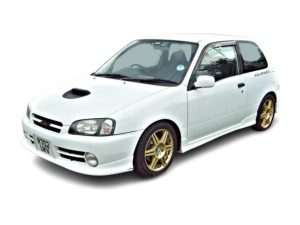
The Toyota Starlet looks like a product of an era when small cars were allowed to be small, rather than being inflated into miniature SUVs with the aerodynamic grace of a refrigerator. Depending on whether you are looking at an EP82 or EP91, the styling ranges from boxy late-1980s charm to the smoother, rounder appearance of the 1990s Starlet. The compact hatchback proportions are one of its biggest strengths in Bangladesh. At roughly 3.7–3.8 metres long and around 1.6 metres wide, the Starlet is genuinely easy to squeeze through narrow Dhaka streets, crowded markets and awkward parking spaces. The 2,300mm wheelbase also contributes to its nimble character. Glanza and GT versions look considerably sportier, particularly with their deeper bumpers, spoilers and performance-oriented appearance. Naturally aspirated Reflet and Soleil versions are much more understated. The problem is that time has not been kind to every Starlet. Rust, repaired accident damage, mismatched panels, faded paint and badly fitted body kits are common things to watch for in the Bangladesh used market. A clean original-bodied Starlet can still look remarkably charming, but a neglected example can look like it has survived several wars and a particularly enthusiastic mechanic. Overall, the Starlet's exterior remains compact, practical and surprisingly attractive when properly maintained.

Interior

Inside, the Starlet is simple rather than luxurious. There is no giant touchscreen, digital mood lighting or dashboard attempting to communicate with satellites. Instead, you get a straightforward 1990s cabin designed around the driver and basic everyday usability. The front seats provide reasonable comfort for a small hatchback, while the upright driving position makes the car easy to place on narrow Bangladesh roads. Visibility is another advantage. The relatively compact dimensions and straightforward dashboard make judging the corners considerably easier than in many modern cars. Rear-seat space is where the Starlet reminds you that it is, fundamentally, a small hatchback. Two adults can sit comfortably enough for shorter journeys, but three adults across the rear becomes a compromise. Boot capacity is useful for groceries and everyday luggage, but it obviously cannot compete with a larger sedan. Interior quality depends enormously on the individual example. Some cars have surprisingly clean original dashboards and upholstery, while others have cracked plastics, replaced seats, aftermarket audio equipment and wiring modifications everywhere you look. For Bangladesh, air conditioning is particularly important, and a properly functioning factory-style AC system can make the Starlet perfectly usable in hot weather. The cabin is not luxurious, but its simplicity is actually part of its charm.

Features

The Starlet's feature list needs to be judged against the 1990s rather than 2026. Power steering, power windows, air conditioning, central locking, tachometer, rear wiper, fog lamps, alloy wheels and upgraded interiors were available depending on grade and market.

Later EP91 versions could also offer useful equipment such as airbags and ABS, while sportier Glanza variants received more performance-oriented equipment. Toyota's own documentation shows that the fifth-generation Starlet introduced driver SRS airbag equipment as standard, with passenger SRS available as an option.

But there is no escaping the fact that modern conveniences are largely absent. Factory Bluetooth, Apple CarPlay, Android Auto, touchscreen navigation, wireless charging, adaptive cruise control and connected-car services simply belong to another generation.

Fortunately, this is Bangladesh, where the aftermarket is practically a national sport. A modern touchscreen, reverse camera, Bluetooth audio and USB charging can easily be added to a Starlet. That makes the car more usable without fundamentally changing what it is.

The standout feature remains the basic mechanical philosophy: light body, small engine, simple controls and relatively uncomplicated systems. That simplicity can be a genuine advantage when maintaining an old car.

Safety

Safety is the area where the Starlet shows its age most clearly. A modern car surrounds you with multiple airbags, electronic stability control, collision avoidance systems, lane assistance and sophisticated crash structures. The Starlet was designed long before that technology became normal. Later EP91 models were significantly better equipped than some earlier cars. Toyota documented a driver-side SRS airbag as standard and a passenger-side SRS airbag as an option, while ABS was available depending on specification. However, you should not expect side airbags, curtain airbags, electronic stability control, blind-spot monitoring, automatic emergency braking, lane-keeping assistance or modern ADAS. They simply were not part of the Starlet's original engineering philosophy. In real-world Bangladesh driving, the Starlet's biggest safety advantages are its compact size, good visibility and predictable controls. Its lightweight body also makes it easy to maneuver around obstacles. The important caveat is that a 30-year-old vehicle's actual safety condition depends heavily on its structural history. A badly repaired accident car is a different proposition from a straight, original example. Check chassis rails, pillars, floor sections, doors, seat belts, airbags and previous accident repairs carefully. The Starlet can be safely driven within its limits, but it should not be mistaken for a modern five-star safety car.

Driving Experience

This is where the Starlet becomes rather entertaining. The naturally aspirated 1.3-litre engine is not going to rearrange your organs, but the car itself is wonderfully light. Toyota's historical specifications show how little these cars weigh, with many versions comfortably below one tonne. That low weight gives the Starlet an immediacy that many modern cars have lost. Steering feels manageable, the body responds quickly and the small dimensions make it extremely easy to place on the road. In Dhaka traffic, the Starlet's compact size is genuinely useful. You can navigate narrow streets, squeeze into parking spaces and make tight turns without feeling as though you are piloting a bus. The naturally aspirated versions are best thought of as relaxed urban cars. Acceleration is adequate rather than spectacular. On highways, they can maintain normal cruising speeds, although overtaking requires more planning than it would in a modern 1.5-litre sedan. Then there is the Glanza. The 4E-FTE turbocharged engine produces approximately 135 PS and 156.9 Nm, turning the tiny hatchback into something considerably more mischievous. For Bangladesh, a healthy naturally aspirated Starlet is the sensible everyday choice. A genuine Glanza is the enthusiast's choice. Either way, the lightweight chassis is the thing that makes the Starlet memorable.
EXPLORE THE RANGE

Variants

The Starlet name covers several generations and grades, so it is important not to treat every 1989–1996 car as mechanically identical. The period includes the fourth-generation EP82 and the beginning of the fifth-generation EP91.

The EP82 range included economical naturally aspirated models using Toyota's 4E engine family, alongside the much more performance-focused turbocharged GT versions. Toyota's contemporary documentation describes the 4E-FTE as a 1.3-litre inline-four turbo producing 135 PS, while the naturally aspirated 4E-F and 4E-FE engines targeted economy and everyday drivability.

The EP91 brought names such as Reflet, Glanza S and Glanza V. The Glanza V is the one enthusiasts tend to care about because it uses the 4E-FTE turbo engine. Toyota's Japanese specifications list the Glanza V at 135 PS and 156.9 Nm.

For normal Bangladesh use, the naturally aspirated Starlet makes more sense if you want straightforward commuting and easier ownership. The Glanza is a different animal: faster, more interesting and considerably more desirable to enthusiasts, but condition and originality become critical.

Overall, the Starlet remains an unusually appealing little Toyota because it combines simplicity, low weight, easy urban maneuverability and genuine driving character. Just remember that you are buying a decades-old car, not a cheap new one.
TRENDING

Trending Toyota Cars

View All Toyota Cars
FAQ

Toyota Starlet Questions & Answers

Toyota Starlet price in Bangladesh currently ranges from around ৳2 lakh to ৳6 lakh. Most ordinary cars are commonly found around ৳3.5–5 lakh, while exceptionally clean, modified or desirable Glanza/Reflet examples can ask more.

View All Toyota Starlet FAQs
📍

Find Dealers Near You

Looking for Toyota Starlet ? We will notify you when verified dealers become available.

💳

Calculate Your Car EMI

Estimate your monthly payment for Toyota Starlet

৳ 30,00,000
৳5L ৳1Cr
৳ 5,00,000
৳0 ৳30L
9%
5% 18%
5 Years
1 Year 7 Years
Your Monthly EMI ৳ 64,250 Estimated payment per month
Principal Amount ৳ 30,00,000
Total Interest ৳ 7,68,000
Total Payment ৳ 37,68,000