5.0 Expert Rating

Toyota Starlet 4th Gen (1989-1996) Expert Review

Extensively tested and reviewed by Team CarHub

EXPERT VERDICT
"
Toyota Starlet is a lightweight, economical and surprisingly fun hatchback, with simple mechanics and excellent suitability for Bangladesh's crowded city streets.
AT A GLANCE

Pros & Cons

✓
WHAT WE LIKE

Good Things

  • ✓
    Very lightweight and agile
  • ✓
    Excellent city maneuverability
  • ✓
    Simple mechanical construction
  • ✓
    Good fuel economy
−
WHAT COULD BE BETTER

Could Be Better

  • −
    Very old safety technology
  • −
    Limited cabin space
  • −
    Weak modern features
  • −
    Age-related mechanical issues
Toyota Starlet 4th Gen (1989-1996)
— 41 Reviews
৳ 2.50 Lakh - 6.00 Lakh

Exterior

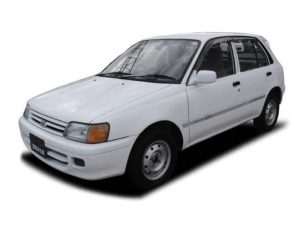
The Toyota Starlet was never meant to be a giant status symbol. It was Toyota's answer to a much simpler question: how do you make a tiny hatchback useful, economical and entertaining without filling it with unnecessary nonsense? The fourth-generation EP82, launched in 1989, answered that question with a compact three- or five-door body measuring roughly 3.72 metres long. The later EP91 became slightly longer and more rounded, measuring around 3.74–3.79 metres depending on specification.

In Bangladesh, that tiny footprint is a genuine advantage. Dhaka's narrow streets, crowded parking areas and constant traffic make a small hatchback remarkably useful. The Starlet can turn around in approximately 4.4–4.5 metres and takes up very little road space.

The sporty GT and Glanza versions look considerably more aggressive, with spoilers, larger wheels and sportier bumpers. The ordinary Soleil, Si and Reflet versions are much more understated.

There is one problem: age. A 1989 Starlet is now more than 35 years old. Rust, faded paint, repaired accident damage and worn body seals are therefore far more important than whether the car still looks fashionable.

And yet, park a clean Starlet beside a modern hatchback and it has a charm many newer cars have forgotten. It is small, simple and honest.

Interior

Inside, the Starlet is unmistakably a product of its era. There is no giant touchscreen, no ambient lighting designed to make you feel as though you are sitting inside a nightclub and certainly no digital assistant asking whether you would like to order coffee. You get seats, switches, gauges and a steering wheel. How refreshing.

The cabin is compact, but Toyota made sensible use of the available space. Five people can technically sit inside, although four adults are a much more comfortable proposition for longer journeys. The five-door versions are particularly practical because rear access is considerably easier.

The driving position is straightforward, visibility is good and the relatively low dashboard makes the car easy to place on narrow roads. The hatchback design also provides useful luggage flexibility, particularly when the rear seats are folded.

Higher grades and sporty versions can have better upholstery, sportier seats and additional trim, but the fundamental cabin remains simple.

The biggest problem today is not the original design—it is deterioration. A 30-year-old interior may have cracked plastics, sagging roof lining, worn seat fabric, damaged switches and aftermarket audio equipment.

For Bangladesh, the compact cabin works well for urban use. However, if you regularly travel with five adults and luggage, the Starlet's limited interior space becomes obvious.

It is best thought of as a small city hatchback rather than a family limousine.

Features

The Starlet's feature list needs to be viewed through the correct historical lens. In the early 1990s, equipment such as power steering, power windows, air conditioning, central locking and alloy wheels could make a small hatchback feel surprisingly sophisticated. Today, those things are ordinary.

Depending on grade and model year, the Starlet could have power steering, power windows, air conditioning, keyless entry, upgraded audio, alloy wheels, fog lamps, rear spoiler and sport seats. The GT and Glanza versions received considerably more performance-oriented equipment.

The EP82 range also included a canvas-top version, while the EP91 introduced the Glanza name and more modern equipment. Toyota's fifth-generation documentation identifies Reflet and Glanza models, with the Glanza V using the 135-PS turbocharged 4E-FTE.

But here is the amusing bit: many Starlets in Bangladesh have more modern equipment today than they ever had when they left Japan. Touchscreens, rear cameras, DVD players, aftermarket Bluetooth, CNG systems, alarms and LED lights can all be found on individual cars. Those are modifications rather than universal factory specifications.

The original Starlet's greatest feature is actually its weight—or lack of it. At roughly 710–920 kg depending on version, even a modest 1.3L engine can move it with reasonable enthusiasm.

If you want modern technology, you will need aftermarket equipment. If you want simplicity, the Starlet has that in abundance.

Safety

Safety is the area where the Starlet's age becomes impossible to ignore. The earliest EP82 cars were designed before modern electronic safety systems became normal. There is no electronic stability control, no autonomous emergency braking, no lane-departure warning and certainly no radar cruise control.

Basic equipment varies by year and grade. Seat belts, child locks, conventional braking systems and airbags on later/high-grade cars provide some protection. The fifth-generation Starlet represented a significant improvement: Toyota's historical documentation specifically notes driver SRS airbag and ABS as standard equipment, together with the newer GOA safety structure.

That does not mean every 1996 Starlet has the same equipment, and earlier EP82 examples should be treated separately.

For a Bangladesh used car, the condition of the chassis is particularly important. You should inspect for accident repairs, rust, poorly repaired structural damage and damaged suspension mounting points.

The absence of modern ADAS is obvious, but that is not surprising. This is a car designed before those systems existed in their current form.

The Starlet's small dimensions can help you avoid trouble in crowded streets because visibility is good and the car is easy to control. But in terms of crash protection and active safety, it cannot compete with a modern Toyota.

If safety technology is a major priority, the age of the Starlet is its biggest limitation.

Driving Experience

Now we arrive at the part where the Starlet becomes genuinely interesting. The car is tiny. It weighs very little. And Toyota put some rather enthusiastic engines into it.

The ordinary naturally aspirated EP82 used engines producing roughly 82–100 PS, while the GT received the 1.3L 4E-FTE turbo with 135 PS. The fifth-generation Glanza V continued the formula with another 135-PS 4E-FTE.

The result is a car that can feel much quicker than its engine capacity suggests. The naturally aspirated versions are perfectly adequate around town, while the GT and Glanza V are a completely different animal.

The common naturally aspirated car is particularly suited to Bangladesh's city environment. It is narrow, light, easy to park and responsive enough for normal traffic. The steering is simple and the car feels nimble because there simply isn't much mass to throw around.

On highways, the 1.3L engine is adequate but not spectacular. With passengers and luggage, overtaking requires planning. The turbo versions are another story entirely and are far more performance-focused.

Fuel economy is also a major strength. A healthy naturally aspirated car can realistically achieve around 8–11 km/L in Dhaka and 14–17 km/L on highways, although age and maintenance condition have enormous influence.

The real issue is not the original driving dynamics. It is finding one that still drives like Toyota intended after decades of use.

EXPLORE THE RANGE

Variants

The 1989–1995 EP82 range included grades such as Soleil, Si and GT, with different naturally aspirated engines and the famous 135-PS GT turbo. Toyota's historical records list the 3-door GT, 3-door Soleil and 5-door Si as representative EP82 grades.

The 1996 EP91 moved into the Reflet and Glanza era. Toyota offered naturally aspirated 1.3L 4E-FE versions producing 85 PS and the sporty Glanza V with the 135-PS turbocharged 4E-FTE. Five-speed manuals and four-speed automatics were available depending on model and grade.

For normal Bangladesh use, the naturally aspirated versions are the straightforward choices. They are simpler and generally more economical. The turbo GT/Glanza models appeal to enthusiasts who specifically want performance from a tiny Toyota.

The most important thing today, however, is not the badge on the boot. It is the condition underneath it. These cars are old enough that engine swaps, CNG conversions, aftermarket body kits, suspension modifications and repaired accident damage are common possibilities.

A clean original or properly maintained Starlet can be charming, economical and surprisingly entertaining. A neglected example can become a project.

The Starlet's greatest achievement is that after all these years, a tiny 1.3L Toyota hatchback can still make a modern traffic-filled city feel like a playground.

TRENDING

Trending Toyota Cars

View All Toyota Cars
FAQ

Toyota Starlet 4th Gen (1989-1996) Questions & Answers

Toyota Starlet price in Bangladesh is currently around ৳2.5 lakh to ৳6 lakh for 1989–1996 models, depending on model year, EP82 or EP91 generation, engine, transmission, condition and registration status

View All Toyota Starlet 4th Gen (1989-1996) FAQs
📍

Find Dealers Near You

Looking for Toyota Starlet 4th Gen (1989-1996) ? We will notify you when verified dealers become available.

💳

Calculate Your Car EMI

Estimate your monthly payment for Toyota Starlet 4th Gen (1989-1996)

৳ 30,00,000
৳5L ৳1Cr
৳ 5,00,000
৳0 ৳30L
9%
5% 18%
5 Years
1 Year 7 Years
Your Monthly EMI ৳ 64,250 Estimated payment per month
Principal Amount ৳ 30,00,000
Total Interest ৳ 7,68,000
Total Payment ৳ 37,68,000