3.5 Expert Rating

Toyota Sienta 1st Gen (2003-2015) Expert Review

Extensively tested and reviewed by Team CarHub

EXPERT VERDICT
"
Toyota Sienta 2003-2015 models are practical, economical seven-seat MPV with excellent space efficiency, easy city driving and affordable Toyota ownership.
AT A GLANCE

Pros & Cons

✓
WHAT WE LIKE

Good Things

  • ✓
    Excellent seven-seat practicality
  • ✓
    Compact city-friendly dimensions
  • ✓
    Useful sliding rear doors
  • ✓
    Reliable 1.5L engine
−
WHAT COULD BE BETTER

Could Be Better

  • −
    Affordable replacement parts
  • −
    Tight third-row seating
  • −
    Modest highway performance
  • −
    Outdated interior technology
Toyota Sienta 1st Gen (2003-2015)
— 50 Reviews
৳ 8.00 Lakh - 17.00 Lakh

Exterior

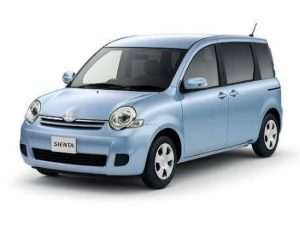
The first-generation Toyota Sienta arrived in 2003 with a rather clever idea: take the practicality of a seven-seat MPV and squeeze it into a compact five-number Japanese body. Toyota called it a “compact minivan” with seven seats and sliding doors, and that description remains remarkably accurate more than two decades later.

The design is simple rather than dramatic. The rounded nose, tall roof and compact rear section give the Sienta a friendly appearance, while the large side sliding doors immediately reveal what the car is really about: practicality. It measures approximately 4,100 mm long, 1,695 mm wide and 1,670 mm high in its common FF configuration, with a 2,700 mm wheelbase.

For Bangladesh, those dimensions are extremely useful. The car is narrow enough for congested Dhaka streets and relatively easy to park. The 5.2-metre turning radius of the FF version also helps when manoeuvring through tight roads and parking areas.

The downside is the ground clearance. At around 140 mm on the common FF version, the Sienta is not designed for the sort of enormous speed breakers and crater-like potholes found on poorly maintained Bangladeshi roads.

The later facelifted versions look slightly more modern, but the basic formula never changed. It is not an SUV, it is not trying to look expensive and it certainly isn't pretending to be sporty. It is simply a compact box designed to carry people efficiently.

Interior

Sienta's interior is the reason this little MPV has remained relevant in Bangladesh's used-car market. Toyota managed to put seven seats inside a vehicle only around 4.1 metres long, which is rather like fitting a family apartment into a studio flat and somehow making the plumbing work.

The dashboard is straightforward, with controls positioned for easy use. The driving position is relatively upright, visibility is good and the cabin feels more spacious than the exterior dimensions suggest.

The second row provides useful passenger space, while the third row folds away when it is not needed. This means the Sienta can switch between carrying people and carrying luggage without requiring a gigantic body.

But there is an obvious compromise. The third row is not luxurious. Adults can use it for shorter trips, but anyone expecting Toyota Alphard levels of legroom will be disappointed. Children are far happier occupants back there.

The sliding rear doors are arguably the interior's greatest practical feature. They make getting passengers into the car much easier when parked tightly beside another vehicle.

Material quality is durable rather than luxurious, and the interior technology is now old-fashioned. There is no modern connected-car experience, wireless smartphone integration or sophisticated digital dashboard.

But for a family wanting a used Toyota Sienta in Bangladesh, the important thing is that the interior remains extremely functional.

Features

Sienta's equipment changed considerably throughout its long 2003–2015 production period. Toyota sold it in grades such as X, G, X E Package, X S Edition and later DICE/DICE-G versions, with additional special editions.

Even the basic versions provide the essentials: power steering, power windows, air conditioning, central locking, adjustable seating and folding rear seats. Higher grades add more desirable equipment such as automatic climate control, power sliding doors, keyless entry, upgraded audio systems, alloy wheels and improved interior trim.

Some later versions were considerably better equipped than the earliest 2003–2005 cars. The 2013 DICE-G, for example, added equipment including a passenger-side power sliding door, automatic air conditioning, Plasmacluster air purification and additional interior upgrades.

That makes the grade and year important when comparing cars.

The Sienta's most useful technology is still wonderfully mechanical: sliding doors and folding seats. They solve everyday problems rather than merely looking impressive on a specification sheet.

What you will not get is modern smartphone integration, wireless charging, connected services or modern ADAS. If you want those things, an older Sienta will require aftermarket equipment.

But if your priorities are air conditioning, seating, storage, power windows and practical family use, the Sienta still gets the important things right.

Safety

Safety equipment is one area where the age of the first-generation Sienta becomes obvious. Early examples were developed at a time when modern ADAS technology was not yet commonplace.

The basic safety package includes conventional equipment such as driver and passenger airbags, seat belts, child locks and braking assistance depending on grade. Later versions improved the package, and Toyota's catalogue notes that VSC and TRC became standard on 2WD vehicles during the later production period.

ABS availability varies by grade and year, so you should not assume that every 2003–2015 Sienta has exactly the same safety equipment.

There is no modern Toyota Safety Sense system here. You will not find factory adaptive cruise control, lane-centering, forward collision avoidance or traffic-sign recognition.

For a Bangladesh used-car purchase, the physical condition of the car therefore becomes particularly important. Check the airbags, ABS system, tyres, brakes, suspension and chassis carefully. A vehicle that has suffered a serious accident and been poorly repaired can have safety problems that are not obvious from the exterior.

The Sienta's compact size and good visibility are useful in urban driving, while its seven-seat configuration provides practical family transportation. But compared with modern cars, its active-safety technology is clearly dated.

In short, the Sienta has the conventional safety fundamentals, but you should not expect 2026-level driver assistance from a car whose basic design dates back to 2003.

Driving Experience

The first-generation Sienta uses Toyota's familiar 1.5L 1NZ-FE four-cylinder petrol engine. In the common FF configuration it produces 110 hp and 141 Nm, while the 4WD version produces approximately 105 hp and 138 Nm.

It is a calm, sensible powertrain rather than an exciting one. The FF version's CVT keeps the engine operating smoothly and is particularly comfortable in urban traffic. The 4WD version uses a four-speed automatic and has slightly different performance and fuel economy characteristics.

Around Dhaka, the Sienta's compact dimensions are a bigger advantage than outright power. You can place it easily on narrow roads, squeeze into parking spaces and manoeuvre around traffic without feeling as though you are piloting a bus.

The engine is adequate when the car is lightly loaded. Add seven people, luggage and the air conditioner, however, and the Sienta becomes noticeably slower. Overtaking on highways requires planning.

Toyota's original Japanese test cycle quoted up to 19.0 km/L for the early FF model, but Bangladesh conditions are very different. In actual Dhaka driving, around 8–10 km/L is a more realistic expectation, with approximately 13–15 km/L on highways from a healthy petrol example.

The suspension provides reasonable comfort, but the low ground clearance requires caution over Bangladeshi speed breakers.

It is not thrilling. It is useful. And for a family MPV, that is arguably the point.

EXPLORE THE RANGE

Variants

The first-generation Sienta had an unusually long production life, from 2003 to 2015, and Toyota introduced several grades and updates during that period. The main grades included X and G, with X E Package, X S Edition, DICE, DICE-G and various special editions appearing over time.

The standard FF version uses a CVT and produces 110 hp/141 Nm. Japanese-market 4WD versions use a four-speed automatic and produce 105 hp/138 Nm. Toyota also offered seven seats across the main configurations.

The X is the straightforward equipment grade. G adds more convenience and comfort features. Later DICE versions received a different exterior treatment, while DICE-G added equipment such as a power sliding door and automatic climate control.

For Bangladesh, later examples are generally more interesting because they benefit from years of Toyota's running updates. But a clean early car with good mechanical condition can still be perfectly usable.

The key is not simply choosing the highest grade. On a vehicle that may now be 10–20 years old, a healthy engine, transmission, suspension, AC and chassis matter enormously.

The first-generation Sienta's fundamental idea remains excellent: seven seats, sliding doors, compact dimensions and a proven Toyota 1.5L engine. Its technology is old, its third row is tight and its performance is modest, but its practicality remains surprisingly strong.

TRENDING

Trending Toyota Cars

View All Toyota Cars
POPULAR

Popular MPVs

View All MPVs
FAQ

Toyota Sienta 1st Gen (2003-2015) Questions & Answers

Toyota Sienta price in Bangladesh is approximately ৳8 lakh–৳17 lakh, depending on condition, model year, grade and import history.

View All Toyota Sienta 1st Gen (2003-2015) FAQs
📍

Find Dealers Near You

Looking for Toyota Sienta 1st Gen (2003-2015) ? We will notify you when verified dealers become available.

💳

Calculate Your Car EMI

Estimate your monthly payment for Toyota Sienta 1st Gen (2003-2015)

৳ 30,00,000
৳5L ৳1Cr
৳ 5,00,000
৳0 ৳30L
9%
5% 18%
5 Years
1 Year 7 Years
Your Monthly EMI ৳ 64,250 Estimated payment per month
Principal Amount ৳ 30,00,000
Total Interest ৳ 7,68,000
Total Payment ৳ 37,68,000