4.0 Expert Rating

Toyota Sienta Hybrid (2015-2022) Expert Review

Extensively tested and reviewed by Team CarHub

EXPERT VERDICT
"
Toyota Sienta 2015-2022 is a practical, economical and versatile compact MPV, especially useful for Bangladeshi families needing seven-seat flexibility.
AT A GLANCE

Pros & Cons

✓
WHAT WE LIKE

Good Things

  • ✓
    Excellent interior practicality
  • ✓
    Very useful sliding doors
  • ✓
    Strong hybrid fuel economy
  • ✓
    Compact Dhaka-friendly dimensions
−
WHAT COULD BE BETTER

Could Be Better

  • −
    Low ground clearance
  • −
    Third-row space is tight
  • −
    Modest 1.5L performance
  • −
    Older safety technology
Toyota Sienta Hybrid (2015-2022)
— 49 Reviews
৳ 15.00 Lakh - 33.00 Lakh

Exterior

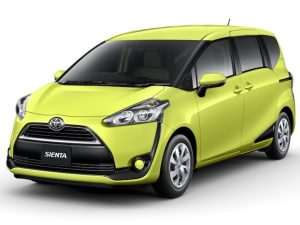
The second-generation Toyota Sienta has one of those designs that refuses to disappear into the traffic. Toyota gave it a compact MPV body with a tall cabin, sliding rear doors and a face that looks rather like someone has drawn a moustache on a family car. It is not conventionally beautiful, but it is distinctive, practical and surprisingly clever. The 2015–2018 version has the more adventurous original styling, while the 2018 facelift received a cleaner front-end treatment and revised lighting. Toyota kept the body within the useful compact dimensions of roughly 4.2–4.26 metres long and 1.695 metres wide, which is extremely useful in Bangladesh.

For Dhaka, the sliding doors are arguably more important than the styling. They make getting children or elderly passengers out of the car considerably easier in tight parking spaces. The elevated roof provides a useful cabin without turning the Sienta into a huge vehicle. Higher grades can look considerably smarter with alloy wheels, upgraded lamps and exterior detailing. The problem is ground clearance. This is still a low compact MPV, so large Bangladeshi speed breakers and broken roads require some respect. Overall, the exterior is functional first, distinctive second and glamorous somewhere around page three.

Interior

Inside, the Sienta is considerably more clever than its exterior suggests. The dashboard is compact and functional, visibility is good and Toyota has concentrated on making the available space useful rather than filling it with unnecessary decoration. The driving position gives you a commanding view of traffic without making the vehicle feel like a bus. That is precisely the sort of thing that works well in Dhaka.

The biggest party trick is the seating arrangement. The standard configuration can accommodate six or seven people depending on specification, while later Funbase versions provide five seats and substantially more luggage-oriented practicality. Toyota's Japanese catalogue confirms both three-row and two-row configurations.

The second row is useful for families, while the third row is best regarded as occasional seating rather than a permanent adult lounge. Children will be happier back there than six-foot adults. Fold the seats away and the Sienta becomes a remarkably useful little load carrier.

Storage spaces, cup holders and flexible seating make the interior practical for everyday Bangladeshi family life. The areas that feel dated today are the infotainment system, cabin materials and lack of modern smartphone integration. Compared with a newer MPV, the Sienta's cabin is clever rather than luxurious.

Features

Sienta's equipment varies substantially according to year and grade, so there is no single specification that represents every Japanese-market car. The basic versions concentrate on useful equipment such as power windows, power steering, air conditioning, central locking, folding seats and multiple storage areas. Higher grades add features such as automatic climate control, keyless entry, push-button start, leather-trimmed steering wheels, alloy wheels, fog lamps and upgraded audio/navigation equipment. Toyota's catalogue confirms significant equipment differences between X, G and G Cuero grades.

The most useful feature in Bangladesh is not actually a touchscreen. It is the sliding rear doors. They make the Sienta genuinely convenient when parked beside another car or when passengers are getting out beside a busy road. The flexible rear seating is another major advantage.

Hybrid versions add the appeal of lower fuel consumption, especially in stop-start traffic. Toyota quoted up to 28.8 km/L under Japan's JC08 testing for the hybrid, although Bangladesh users should expect substantially less in real-world conditions.

What feels dated is the technology. Typical JDM examples do not provide the modern Apple CarPlay, Android Auto, adaptive cruise and connected-car technology you would expect from a newer MPV. The Sienta's technology is therefore practical rather than cutting-edge.

Safety

Safety depends heavily on model year and grade. The basic Sienta package includes important fundamentals such as ABS, Brake Assist, EBD, stability control, airbags, seat-belt systems, child-seat mounting provisions and an immobilizer. Toyota's official specifications document ABS, Brake Assist, EBD and stability control as part of the safety equipment.

The 2018 facelift is particularly significant because Toyota expanded Toyota Safety Sense availability and added pedestrian detection capability. On appropriately equipped cars, this can provide forward-collision warning, automatic braking and lane-departure warning.

But do not confuse Toyota Safety Sense C with the sophisticated ADAS package found in a modern 2025–2026 vehicle. The second-generation Sienta generally does not have adaptive cruise control, lane-centering, traffic-sign recognition, blind-spot monitoring or rear cross-traffic collision avoidance.

In real-world Bangladesh use, the fundamentals matter enormously. Good tyres, functioning ABS/VSC, healthy brakes, properly maintained suspension and a structurally sound body are more important than having a long equipment list. A repaired accident car with every electronic feature imaginable is still not preferable to a structurally healthy example. Check the airbags and warning lights carefully before purchasing.

Driving Experience

Sienta drives exactly as its shape suggests: calmly, efficiently and with an emphasis on getting people somewhere rather than entertaining the driver. The 1.5L petrol engine produces roughly 103–109 hp depending on configuration, while the hybrid uses Toyota's 1.5L hybrid system. Japanese specifications confirm the 109-hp 2NR-FKE petrol engine and 74-hp 1NZ-FXE hybrid engine.

Acceleration is adequate rather than exciting. Put seven people and luggage inside and you will quickly discover that physics remains stubbornly employed. Overtaking requires some planning, especially with the naturally aspirated petrol engine. The CVT is smooth in traffic and suits the Sienta's personality very well.

For Dhaka, however, this setup makes enormous sense. The compact dimensions, light steering, automatic transmission and good visibility make the Sienta easy to thread through crowded streets. The hybrid is particularly pleasant in slow traffic because the powertrain is quiet and efficient at low speeds.

Long-distance driving is comfortable enough, although the low ground clearance requires caution on rough roads. At highway speeds the car is stable, but it is not a high-speed touring machine. The Sienta is fundamentally a practical family MPV, and once you accept that, its driving character makes considerably more sense.

EXPLORE THE RANGE

Variants

Japanese-market second-generation Sienta was sold in several petrol and hybrid grades, including X, G and G Cuero, with Hybrid X, Hybrid G and Hybrid G Cuero versions. Toyota also introduced the five-seat Funbase configuration from the 2018 facelift.

The X is the straightforward version, concentrating on basic practicality. The G adds useful convenience and comfort equipment and is a more feature-rich configuration. G Cuero sits toward the premium end of the range and adds further equipment and styling upgrades. Hybrid versions use the 1NZ-FXE powertrain and are especially attractive for fuel-conscious urban driving. Toyota's official data lists the hybrid at 28.8 km/L under Japan's JC08 test cycle, though real Bangladesh consumption will be much lower.

There are also 4WD petrol versions, while most Sientas encountered in Bangladesh are front-wheel-drive imports. The six- and seven-seat configurations make the model particularly useful for families, whereas the five-seat Funbase makes more sense if luggage and cargo flexibility matter more than maximum passenger capacity.

The important thing is to identify the exact grade and powertrain rather than assuming every Sienta has identical equipment. Overall, the model's appeal comes from the combination of compact size, sliding doors, flexible seating and Toyota's proven 1.5L powertrains. It is not glamorous. It is simply very clever.

TRENDING

Trending Toyota Cars

View All Toyota Cars
POPULAR

Popular MPVs

View All MPVs
FAQ

Toyota Sienta Hybrid (2015-2022) Questions & Answers

Toyota Sienta price in Bangladesh is currently around ৳15 lakh to ৳33 lakh for 2015–2022 models. Price varies according to model year, hybrid or petrol powertrain, grade, mileage, auction condition and overall vehicle condition.

View All Toyota Sienta Hybrid (2015-2022) FAQs
📍

Find Dealers Near You

Looking for Toyota Sienta Hybrid (2015-2022) ? We will notify you when verified dealers become available.

💳

Calculate Your Car EMI

Estimate your monthly payment for Toyota Sienta Hybrid (2015-2022)

৳ 30,00,000
৳5L ৳1Cr
৳ 5,00,000
৳0 ৳30L
9%
5% 18%
5 Years
1 Year 7 Years
Your Monthly EMI ৳ 64,250 Estimated payment per month
Principal Amount ৳ 30,00,000
Total Interest ৳ 7,68,000
Total Payment ৳ 37,68,000