5.0 Expert Rating

Toyota Prius U Expert Review

Extensively tested and reviewed by Team CarHub

EXPERT VERDICT
"
Prius U delivers outstanding efficiency, modern safety and refined hybrid performance, while its simpler equipment keeps it below G and Z in luxury.
AT A GLANCE

Pros & Cons

✓
WHAT WE LIKE

Good Things

  • ✓
    Exceptional fuel economy
  • ✓
    Smooth hybrid powertrain
  • ✓
    Modern aerodynamic design
  • ✓
    Strong safety technology
−
WHAT COULD BE BETTER

Could Be Better

  • −
    Low ground clearance
  • −
    Basic U-grade interior
  • −
    Expensive hybrid components
  • −
    Limited rear headroom
Toyota Prius U
— 30 Reviews
৳ 38.00 Lakh - 45.00 Lakh

Exterior

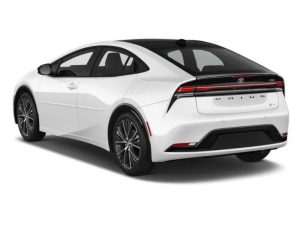
The fifth-generation Toyota Prius is one of the biggest visual departures in the model's history. Instead of the upright, efficiency-first silhouette associated with earlier generations, this version adopts a much lower and sleeker profile. The long bonnet, sharply tapered roofline and narrow lighting elements give it a far more sophisticated appearance. The 4,600 mm body length and 2,750 mm wheelbase create a substantial footprint without making the car feel bulky.

Up front, the slim LED lighting and clean nose give the Prius a distinctly modern appearance. The sides are particularly interesting because the roofline flows almost continuously into the rear section, creating a coupe-like profile while retaining five-door practicality. The flush-style door treatment on higher equipment versions also contributes to the cleaner design.

The aerodynamic shape is not simply cosmetic. Prius has always been engineered around reducing aerodynamic drag, and the fifth generation takes that philosophy considerably further while making the result much more visually appealing.

For local roads, the main concern is not the styling but the relatively low ride height. The approximately 145 mm clearance of the U configuration requires more attention around tall speed breakers, steep ramps and damaged roads.

Interior

Inside, the fifth-generation Prius moves away from the unusual dashboard layout of older generations and adopts a cleaner, more conventional driver-focused arrangement. The digital instrumentation is positioned so important information can be viewed without constantly looking far away from the road.

The dashboard has a minimalist appearance, while the centre section houses the infotainment and climate-control functions. Visibility is generally good at the front, although the dramatically sloping roof and compact rear glass area mean the rear environment feels more enclosed than in a traditional family sedan.

The U grade is deliberately less luxurious than G and Z. Fabric upholstery and simpler equipment keep the cabin focused on efficiency and everyday usability rather than premium presentation. That is not necessarily a problem, because the seating remains comfortable and the interior feels considerably more modern than previous Prius generations.

Rear passengers get adequate space for normal family use, although taller occupants may find the sloping roofline restrictive. The hatchback body remains practical for luggage, while the 60/40 split-folding rear seats increase carrying flexibility.

For daily driving, the cabin's quietness is one of its strongest characteristics. The hybrid system allows the car to move at low speeds with minimal engine noise, giving urban journeys a noticeably calmer character.

Features

The Prius U focuses its equipment around practical technology rather than luxury. Key functions include automatic climate control, smart key access, push-button start, digital instrumentation, Bluetooth connectivity, USB connectivity, LED lighting and Toyota's advanced driver-assistance systems.

Toyota Safety Sense is particularly significant because the fifth-generation Prius introduced a much more comprehensive technology package than older Prius generations. Depending on equipment and market specification, the system can include forward collision warning, automatic emergency braking, lane departure warning, lane tracing assistance, traffic-sign recognition and adaptive cruise control.

The U grade can also be equipped with connected functions and additional technology depending on the Japanese specification and imported unit. This means two apparently identical U cars can have different equipment, so checking the exact chassis and equipment list is important.

The biggest difference from G and Z is the equipment philosophy. U prioritises efficiency and accessibility rather than filling the cabin with premium features. Buyers looking for panoramic cameras, upgraded displays, premium seating and additional convenience equipment should inspect the specific car rather than assuming every Prius U carries the same specification.

Safety

Safety is one of the major advances of the fifth-generation Prius. The platform combines Toyota's modern body structure with a comprehensive electronic safety package. Standard systems on the relevant Japanese specification include ABS, electronic brake-force distribution, brake assist, stability control, traction control, multiple airbags and ISOFIX child-seat mounting points.

The driver-assistance technology is even more significant. Forward collision detection and automatic emergency braking can help reduce the consequences of an imminent frontal collision, while lane-related systems assist with maintaining the vehicle's position on the road. Traffic-sign recognition and adaptive cruise control add another layer of assistance during longer journeys.

Higher-equipment configurations can add blind-spot monitoring, rear cross-traffic assistance and camera-based parking technology.

Real-world safety, however, still depends on tyres, brakes, suspension condition, driver attention and the condition of the imported vehicle. A damaged radar sensor, poorly repaired bumper or incorrectly calibrated camera can affect driver-assistance functions, making proper inspection particularly important for a reconditioned Prius.

Driving Experience

The 1.8L Prius U is fundamentally different in character from the 2.0L G and Z. Its 2ZR-FXE engine and hybrid system produce 140 PS, while the electric motor provides immediate response at low speeds. The result is not a sports-car experience, but acceleration feels more responsive than the engine specification alone might suggest.

In Dhaka traffic, this powertrain makes considerable sense. The car can move smoothly using electric assistance during low-load conditions, and regenerative braking recovers energy when slowing down. The E-CVT keeps the drivetrain extremely smooth because there are no conventional gear changes to interrupt acceleration.

At highway speeds, the Prius U remains composed and quiet, although the 1.8L version does not have the same punch as the 2.0L Prius G. Overtaking requires a little more planning when the car is heavily loaded.

Ride comfort is generally good, but the low ride height means rough roads demand attention. On smooth roads, the long wheelbase and low centre of gravity give the car a planted feeling. Around town, light steering and smooth hybrid operation make it particularly easy to drive.

Fuel economy is where the U earns its reputation. Toyota quotes 32.6 km/L WLTC for the 2WD configuration, but Bangladesh traffic, heat, air-conditioning use and road conditions mean real-world consumption will be considerably lower.

EXPLORE THE RANGE

Variants

The fifth-generation Prius lineup is built around several distinct grades and powertrains. The U is the efficiency-focused 1.8L hybrid grade. It is designed around economical operation and was originally positioned as a KINTO-oriented grade in Japan, with Toyota describing its "upgrade-ready" concept as allowing equipment additions through the ownership/service ecosystem.

The G and Z move to the 2.0L hybrid system and provide greater performance, with substantially more system output than U. G occupies the middle of the conventional hybrid range, while Z is positioned with more premium equipment.

There is also an E-Four AWD version of the U in Japan, using an electrically driven rear axle. Most U cars encountered in Bangladesh are 2WD/FWD, however, so the exact drivetrain should always be confirmed from the chassis information.

For someone specifically looking at the Prius U price in Bangladesh, the appeal is its combination of the new-generation design and excellent fuel economy without paying for the 2.0L powertrain and higher-grade equipment. Current 2023 U listings around ৳40–44 lakh provide a useful picture of where this package sits in the local reconditioned market.

TRENDING

Trending Toyota Cars

View All Toyota Cars
FAQ

Toyota Prius U Questions & Answers

Toyota Prius price in Bangladesh is approximately 38-45 lakh, depending on different model trim and options.

View All Toyota Prius U FAQs
📍

Find Dealers Near You

Looking for Toyota Prius U ? We will notify you when verified dealers become available.

💳

Calculate Your Car EMI

Estimate your monthly payment for Toyota Prius U

৳ 30,00,000
৳5L ৳1Cr
৳ 5,00,000
৳0 ৳30L
9%
5% 18%
5 Years
1 Year 7 Years
Your Monthly EMI ৳ 64,250 Estimated payment per month
Principal Amount ৳ 30,00,000
Total Interest ৳ 7,68,000
Total Payment ৳ 37,68,000