5.0 Expert Rating

Toyota Prius G Expert Review

Extensively tested and reviewed by Team CarHub

EXPERT VERDICT
"
Toyota Prius G combines strong hybrid performance, excellent efficiency and advanced safety in a stylish package.
AT A GLANCE

Pros & Cons

✓
WHAT WE LIKE

Good Things

  • ✓
    Strong hybrid performance
  • ✓
    Excellent fuel economy
  • ✓
    Advanced safety technology
  • ✓
    Modern attractive design
−
WHAT COULD BE BETTER

Could Be Better

  • −
    Low ground clearance
  • −
    Expensive purchase price
  • −
    Limited rear headroom
  • −
    Large 19-inch tyres
Toyota Prius G
— 43 Reviews
৳ 40.00 Lakh - 55.00 Lakh

Exterior

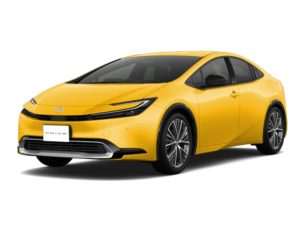
The fifth-generation Prius finally looks as futuristic as its engineering always suggested it should. Toyota abandoned the slightly awkward proportions of the previous generation and created a much cleaner, lower and more dramatic silhouette. The bonnet is long, the windscreen is heavily raked and the roof flows almost uninterrupted into the rear hatch. At 4,600 mm long, 1,780 mm wide and 1,430 mm high, the G is a substantial car without becoming enormous. Its 2,750 mm wheelbase provides a stable footprint, while the low roof and wide stance give it a far more sporting appearance than earlier Prius generations. Toyota's official dimensions confirm these measurements. The G's standard 19-inch wheels contribute heavily to its appearance. They fill the arches beautifully and make the Prius look more like a modern fastback than an economy hybrid. LED lighting and the clean body surfaces complete the effect. There is, however, a price for all this visual drama. The low roof compromises rear headroom, and the low body needs careful treatment on Bangladesh's speed breakers and damaged roads. The Prius G is therefore an interesting combination: visually sporty, technically efficient and aerodynamically clever, but not particularly friendly to roads that resemble an obstacle course.

Interior

Inside, the fifth-generation Prius finally feels like Toyota has stopped apologising for building a hybrid and decided to make the cabin genuinely desirable.

The dashboard is clean and modern, with a digital instrument display and a large central infotainment screen. The driving position feels more conventional than the previous generation, while the lower seating position contributes to the car's sporting character.

The 2,750 mm wheelbase gives the cabin respectable space, but the dramatic roofline means rear headroom is not its strongest point. Adults can sit comfortably, but taller passengers may find the rear less generous than the Prius's exterior size suggests.

The G is positioned as a well-equipped middle grade. Depending on market and equipment package, it can bring smart entry, push-button start, automatic climate control, heated seats, wireless charging, upgraded audio and other useful equipment. Toyota's current G examples also show features such as Smart Key, display audio, parking-related equipment and BSM depending on specification.

The biggest improvement is the feeling of quality. The old Prius could sometimes feel like an engineering exercise with seats attached. This one feels like an actual modern passenger car.

The only real compromise is practicality: the beautiful roofline takes some space away from the rear occupants.

Features

This is where the Prius G becomes seriously impressive. The 2.0L fifth-generation hybrid system is already a major piece of technology. Toyota uses the M20A-FXS Atkinson-cycle engine with a high-output electric motor, producing up to 196 PS in the 2WD hybrid configuration. The front motor itself produces 113 PS and 206 Nm, giving the car the instant response hybrids are known for. The G also brings the technology that modern Prius buyers expect: digital displays, touchscreen infotainment, Bluetooth, smartphone connectivity, smart entry, push-button starting, automatic climate control and advanced cruise control. Toyota Safety Sense is standard across the modern Prius range, while G equipment includes blind-spot monitoring and related rear-vehicle safety functions. Depending on specification, panoramic-view monitoring, parking assistance and additional connected services can be added. The most important point for a used importer is that “G” does not mean every possible option is installed. Some cars have panoramic cameras, upgraded displays, wireless charging and additional assistance systems; others do not. That distinction matters in Bangladesh because two visually identical Japanese imports can have surprisingly different equipment lists.

Safety

The fifth-generation Prius is a completely different proposition from the older Prius generations when it comes to active safety.

Toyota Safety Sense provides a comprehensive collection of driver-assistance systems, including Pre-Collision Safety, Lane Departure Alert, Lane Tracing Assist, Road Sign Assist, Automatic High Beam and Dynamic Radar Cruise Control. Toyota's current Prius documentation also identifies Lane Change Assist and additional rear-vehicle warning functions.

The G adds Blind Spot Monitoring and related systems as standard equipment in Toyota's current Japanese specification. Toyota describes the BSM package as monitoring vehicles approaching from the rear-side areas that are difficult to see in the mirrors.

The car also uses multiple airbags, ABS, EBD, Brake Assist, stability control, traction control and an electronically controlled regenerative braking system.

For Bangladesh, the technology has practical value. Adaptive cruise control can reduce fatigue on long highway journeys, while lane assistance and collision warning are useful on busy roads.

But advanced safety systems need proper maintenance. A damaged front radar, incorrectly calibrated camera or badly repaired bumper can interfere with the systems. Windshield replacement is also more important than it sounds because the forward-facing camera depends on correct positioning.

So the Prius G has excellent safety technology, but that technology is only useful when the imported car has been properly repaired and calibrated.

Driving Experience

This is the Prius that finally makes the word “performance” feel appropriate.

The 2.0L M20A-FXS engine produces 152 PS and 188 Nm, while the electric motor contributes 113 PS and 206 Nm. Combined system output reaches approximately 196 PS in the current 2WD hybrid specification.

The result is a Prius that feels considerably more energetic than its predecessors. Toyota's fifth-generation hybrid system was engineered not only for efficiency but also for a more direct relationship between accelerator input, engine speed and vehicle response.

In Dhaka traffic, the electric motor makes the first few metres almost effortless. There is no gear hunting, no traditional automatic shift shock and no need to think about which gear the car wants.

Then, when the road opens, the 2.0L system gives the Prius enough punch to overtake confidently. It is not a sports car, but it no longer feels like one has accidentally selected the slowest option at the traffic-light drag race.

The chassis is also substantially better. The lower centre of gravity and double-wishbone rear suspension give it stable, composed handling.

The weakness is the 19-inch wheel and low body. Broken roads can make the ride firm, and large speed breakers demand care.
EXPLORE THE RANGE

Variants

The modern Prius lineup is more complicated than simply “G versus Z.” For the 2023–2026 generation, Toyota offers G and Z with the 2.0L hybrid system, while U uses the 1.8L hybrid system. Both 2WD and E-Four AWD are available for the standard HEV range.

The G is the sensible middle ground in the 2.0L lineup. It gets the stronger hybrid system and a substantial amount of safety and convenience technology without moving all the way into the equipment-heavy Z specification.

The Z adds more premium equipment and is positioned higher in the range. The U is completely different in purpose: it uses the 1.8L hybrid system and is focused heavily on efficiency and Toyota/KINTO's connected ownership model.

There is also a 2.0L plug-in hybrid G, but it should not be confused with the standard 2.0L G HEV. The PHEV has a substantially different battery system, weight and operating characteristics. Toyota's current specification lists the PHEV G separately from the 2.0L HEV G.

For Bangladesh, the standard 2.0L G HEV is an interesting proposition because it gives substantially more performance than the U while retaining strong hybrid efficiency.

The important thing when buying one is to verify the exact model code, drivetrain, battery type, equipment and auction sheet. With such a technologically dense car, the specification written on an advertisement is not enough.
TRENDING

Trending Toyota Cars

View All Toyota Cars
FAQ

Toyota Prius G Questions & Answers

The Toyota Prius G 2.0L currently sits around ৳40 lakh–৳55 lakh, price depending on year, mileage, auction grade, equipment and condition.

View All Toyota Prius G FAQs
📍

Find Dealers Near You

Looking for Toyota Prius G ? We will notify you when verified dealers become available.

💳

Calculate Your Car EMI

Estimate your monthly payment for Toyota Prius G

৳ 30,00,000
৳5L ৳1Cr
৳ 5,00,000
৳0 ৳30L
9%
5% 18%
5 Years
1 Year 7 Years
Your Monthly EMI ৳ 64,250 Estimated payment per month
Principal Amount ৳ 30,00,000
Total Interest ৳ 7,68,000
Total Payment ৳ 37,68,000