4.0 Expert Rating

Toyota Premio Expert Review

Extensively tested and reviewed by Team CarHub

EXPERT VERDICT
"
Toyota Premio is a comfortable, dependable family sedan with excellent practicality, smooth driving manners and strong resale demand.
AT A GLANCE

Pros & Cons

✓
WHAT WE LIKE

Good Things

  • ✓
    Comfortable ride quality
  • ✓
    Spacious rear seat
  • ✓
    Reliable Toyota engines
  • ✓
    Strong resale demand
−
WHAT COULD BE BETTER

Could Be Better

  • −
    Low ground clearance
  • −
    Aging safety technology
  • −
    Modest 1.5L performance
  • −
    No hybrid option
Toyota Premio
— 40 Reviews
৳ 30.00 – 44.00 Lakh

Exterior

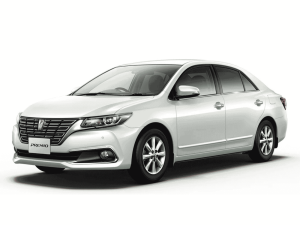
Toyota Premio has never tried to be a boy-racer, and that is precisely why its design has aged rather well. It is a formal Japanese sedan designed around understated elegance rather than aggressive styling. The final-generation car received a more prominent grille, sharper headlights and cleaner body surfacing, giving it a mature road presence without becoming unnecessarily flashy.

In Bangladesh, that restrained design works particularly well. A Premio looks appropriate outside an office, in a family driveway or cruising down a highway. It has the visual proportions people traditionally associate with a proper Japanese sedan: a long bonnet, three-box silhouette, relatively upright cabin and a substantial-looking rear section.

The final model measures 4,595 mm long and 1,695 mm wide, keeping it within Japan's compact five-number sedan philosophy while providing a surprisingly substantial presence. The 2,700 mm wheelbase is especially useful because it contributes to the car's comfortable passenger space.

Higher grades can look significantly more expensive thanks to larger alloy wheels, LED lighting, chrome detailing and upgraded exterior equipment. Lower grades, however, can look rather conservative with steel wheels and simpler lighting.

The weakness is age. Put a Premio beside a modern Corolla or Civic and the styling suddenly reveals its older engineering philosophy. But as a used Japanese sedan for Bangladesh, the Premio's conservative design remains one of its enduring strengths.

Interior

Inside the Toyota Premio, the philosophy changes from Japanese minimalism to something closer to a traditional executive sedan. The dashboard is deliberately calm, with a wide horizontal layout and a generally soft, comfortable atmosphere rather than a giant screen dominating everything.

The biggest advantage is space. Despite its relatively narrow Japanese five-number dimensions, the 2,700 mm wheelbase provides generous passenger accommodation, particularly in the rear. That matters enormously in Bangladesh, where family buyers often spend long hours travelling between Dhaka and other districts.

The rear centre armrest, split-folding rear seat, generous headroom and comfortable seating make the Premio particularly pleasant as a family car. Higher grades can add power-adjustable driver's seats, better upholstery, leather-wrapped controls, wood-style trim and heated seats.

Toyota's final equipment documentation confirms 6:4 split-folding rear seats, rear centre armrest with cupholders, illuminated glovebox, front and rear door storage, vanity mirrors and luggage-area lighting.

But there is a catch: the interior architecture is old. The infotainment experience is nowhere near what you get from a modern Toyota. Apple CarPlay, Android Auto, wireless charging and a large factory touchscreen are not defining features of this car.

Still, if your priorities are comfortable seats, rear passenger space and a quiet family-oriented cabin, the Premio remains very convincing.

Features

The Premio's equipment story depends heavily on the grade and package. Toyota offered 1.5F, 1.8X and 2.0G versions, with L Package and EX Package equipment levels that substantially changed the specification. The higher grades could bring features such as smart entry and push-button start, power driver's seat, premium upholstery, automatic climate control, nanoe air-cleaning technology, leather and wood-style steering controls, better alloy wheels, Bi-Beam LED headlights and additional parking assistance. One particularly useful aspect of the Premio is that many features are genuinely practical rather than gimmicks. The large cabin, rear armrest, split-folding seats, automatic climate-control availability, power windows and comfortable seating all make sense during everyday Bangladesh use. The final model also introduced Toyota Safety Sense equipment including Pre-Crash Safety, Lane Departure Alert, Automatic High Beam and Lead Vehicle Start Alert. Intelligent Clearance Sonar was available as an option on applicable configurations. But this is where the Premio's age becomes obvious. There is no modern connected-car ecosystem, no factory-standard Android Auto or Apple CarPlay, no wireless phone charger, no adaptive cruise and no sophisticated 360-degree camera system. So the Premio's feature list is best described as comfort-focused rather than technology-focused. It gives you the equipment that makes a sedan pleasant to live with, but not the gadgetry of a newer generation.

Safety

The Premio's safety equipment is respectable for its generation, but it needs to be judged as an older Japanese sedan rather than against a brand-new car. The final model came with Toyota Safety Sense including a pre-crash safety system, Lane Departure Alert, Automatic High Beam and Lead Vehicle Start Alert. Toyota also fitted S-VSC, traction control, ABS, EBD and Brake Assist as part of the standard safety package. The braking hardware is straightforward: ventilated discs at the front and drums at the rear. This isn't exotic, but it is a proven setup and appropriate for a family sedan. The 1.5F also uses conventional three-point seat belts with pretensioners and force limiters at the front. The important caveat is airbags. Driver and passenger airbags are standard, while side and curtain airbags were available as options rather than universally standard equipment. ISOFIX child-seat mounting was also available. And then comes the technological gap. There is no adaptive cruise control, blind-spot monitoring, rear cross-traffic alert, lane-keeping assist or modern driver-monitoring system. Toyota's documentation also notes that the pre-crash system did not include pedestrian detection in this configuration. For Bangladesh, the practical lesson is simple: a well-maintained Premio with the proper safety equipment is reassuring, but buyers should not mistake its Toyota Safety Sense branding for the capability of a modern Toyota ADAS package.

Driving Experience

The Toyota Premio is fundamentally a comfort car. It is not designed to make you grin through every corner; it is designed to make the journey disappear. The 1.5L 1NZ-FE produces 109 PS and 136 Nm, and the Super CVT-i keeps the engine in its comfortable operating range without traditional gear changes. In Dhaka traffic, that smoothness is exactly what you want. The CVT makes crawling through congestion easy, the steering is light enough for urban manoeuvring, and the suspension prioritises absorbing broken surfaces rather than transmitting every pothole through the cabin. On the highway, the Premio becomes even more convincing. The long wheelbase and relatively heavy body give it a stable, settled character at cruising speeds. It is the sort of car that can spend hours travelling from Dhaka to Chattogram without making its passengers feel like they have been trapped inside a washing machine. The 1.5L is adequate rather than exciting. Around town it feels perfectly acceptable, but when the car is fully loaded with passengers and luggage, overtaking requires more planning. The 1.8L and 2.0L engines solve that problem with considerably stronger outputs. Bangladesh fuel economy depends heavily on traffic and AC use. Around 9–10 km/L in Dhaka, 14–16 km/L on highways and roughly 12 km/L combined is a sensible real-world expectation for a healthy 1.5L. The Premio's greatest trick is therefore not speed. It is making ordinary journeys feel effortless.
EXPLORE THE RANGE

Variants

Toyota kept the Premio lineup relatively straightforward. In the final generation, the major engine grades were 1.5F, 1.8X and 2.0G, with L Package and EX Package equipment levels layered over them. The 1.8X was available with both 2WD and 4WD, while the 1.5F and 2.0G were offered with 2WD in the final lineup. The 1.5F is the sensible Bangladesh-market choice for buyers focused on fuel economy, daily commuting and lower running costs. Its 109 PS engine is not powerful, but the CVT makes it smooth and predictable. The 1.8X is the middle ground. With 143 PS in 2WD form, it gives the Premio considerably more breathing room when overtaking or carrying a full passenger load. The 4WD version uses a lower-output 131 PS configuration. The 2.0G is the performance-oriented option, producing 152 PS and 193 Nm. It is the choice for someone who wants the Premio's comfort but does not want the 1.5L's relaxed acceleration. EX Package cars add more premium equipment, while L Package versions sit between basic and heavily equipped specifications. Overall, the Premio makes the most sense when bought according to your actual use. For Dhaka commuting, 1.5F is practical. For mixed family use and stronger performance, 1.8X is compelling. For maximum power within the Premio range, 2.0G is the obvious choice.
FAQ

Toyota Premio Questions & Answers

The current Toyota Premio price in Bangladesh is approximately 30–44 lakh Tk depending on different model trim and options.

View All Toyota Premio FAQs
📍

Find Dealers Near You

Looking for Toyota Premio ? We will notify you when verified dealers become available.

💳

Calculate Your Car EMI

Estimate your monthly payment for Toyota Premio

৳ 30,00,000
৳5L ৳1Cr
৳ 5,00,000
৳0 ৳30L
9%
5% 18%
5 Years
1 Year 7 Years
Your Monthly EMI ৳ 64,250 Estimated payment per month
Principal Amount ৳ 30,00,000
Total Interest ৳ 7,68,000
Total Payment ৳ 37,68,000