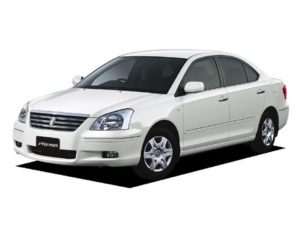
For a car introduced in 2001, the Premio's safety package was reasonably comprehensive for its time. Toyota's standard equipment included driver and passenger airbags, ABS with EBD, Brake Assist, front seat-belt pretensioners and force limiters, plus three-point belts for the rear passengers.
The body was developed around Toyota's GOA collision-safety philosophy, while later versions received additional safety improvements. The facelifted T240 generation also introduced features such as speed-sensitive door locking and seat-belt reminder systems on selected specifications.
That said, this is not a modern safety package. There is no blind-spot monitoring, adaptive cruise control, lane-keeping assist, forward-collision warning, autonomous emergency braking or 360-degree camera from the factory.
Side and curtain airbags were also not part of the standard equipment on the primary 1.5F specification. Toyota's official 2006 equipment list specifically shows driver and passenger airbags as standard while side airbags were not fitted.
For a Bangladesh buyer, the physical condition of the car is therefore extremely important. A structurally damaged Premio with a shiny exterior is not a safe purchase simply because the model has Toyota branding.
Check the chassis, airbags, seat-belt pretensioners, ABS warning light, braking system and accident-repair history.
The Premio's safety equipment was respectable for its era. Just don't judge a 2001–2007 sedan by 2026 ADAS standards.