4.0 Expert Rating

Toyota Passo 1st Gen (2004-2010) Expert Review

Extensively tested and reviewed by Team CarHub

EXPERT VERDICT
"
Toyota Passo 2004–2010 is a practical, economical and easy-to-maintain Japanese hatchback, ideal for budget-conscious  city driving.
AT A GLANCE

Pros & Cons

✓
WHAT WE LIKE

Good Things

  • ✓
    Excellent city maneuverability
  • ✓
    Low running cost
  • ✓
    Reliable 1KR-FE engine
  • ✓
    Compact parking-friendly body
−
WHAT COULD BE BETTER

Could Be Better

  • −
    Slow 1.0L acceleration
  • −
    Basic interior materials
  • −
    Four-speed automatic gearbox
  • −
    Limited modern safety tech
Toyota Passo 1st Gen (2004-2010)
— 32 Reviews
৳ 5.50 – 13.00 Lakh

Exterior

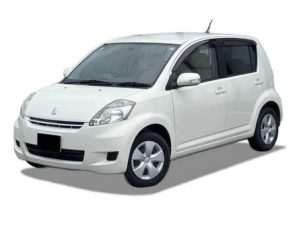
The first-generation Toyota Passo was designed with one very simple idea: make a small car that does not feel like a punishment to live with. And Toyota absolutely nailed the basic brief. The Passo is short, narrow and tall enough to give passengers a surprisingly useful cabin without turning the thing into a van. In Bangladesh, where a Dhaka parking space can sometimes resemble a mathematical problem, that compact footprint is genuinely useful. The original Passo measures roughly 3.6 metres long and 1.67 metres wide, so it is considerably easier to place on narrow city streets than a conventional family sedan. The upright body also gives the driver good visibility around the front corners. The design changed slightly through the generation, particularly around the 2006 facelift, while the Racy version added a more aggressive bumper, side styling, rear spoiler and sportier details. There is nothing particularly luxurious about the exterior. It is a small Japanese hatchback rather than a miniature Lexus. But that is part of the charm. The proportions are practical, the rear hatch is useful and the relatively high roof makes the car feel bigger inside than it looks outside. For Bangladesh, the 160mm ground clearance is reasonably usable, although owners should still slow down for aggressive speed breakers and potholes. A well-maintained suspension makes a huge difference. The best thing about the Passo's exterior is not styling. It is how little space the car needs to do its job.

Interior

Inside the Passo, Toyota was clearly trying to extract maximum usefulness from a very small footprint. The cabin is not glamorous, but it is clever. The tall body and long-for-the-class wheelbase create respectable passenger space, while the dashboard is simple enough that you can understand everything without consulting an instruction manual. The front seats are comfortable for ordinary commuting, and the upright seating position works particularly well in Dhaka traffic because visibility is good. Rear-seat space is acceptable for a compact hatchback, although three adults across the rear will obviously be tighter than in a Premio or Allion. Storage was one of the car's strengths. Toyota deliberately included multiple small storage areas, reflecting the car's original “my partner compact” philosophy. The first-generation model was developed jointly with Daihatsu and was sold in Japan alongside the Daihatsu Boon. Material quality is basic by modern standards. Hard plastics dominate, and there is little of the soft-touch material or sophisticated ambience found in newer Japanese cars. The Racy grade improves the visual experience with a sportier steering wheel, dedicated instrumentation and darker interior treatment. The biggest problem today is not what Toyota put inside the Passo. It is what twenty years of use may have done to it. Worn seat fabric, faded plastics, broken switches and poorly installed aftermarket audio equipment are common things to inspect in a Bangladesh-market used car.

Features

The Passo's equipment list makes sense when viewed through the lens of the mid-2000s rather than 2026. It has the practical things that matter: power steering, power windows, central locking, air-conditioning, tilt steering, foldable rear seats and, depending on grade or package, Toyota's Key Free system. Toyota offered G, X and Racy grades, with F Package and V Package variations. F Package equipment could include the Key Free system and theft-prevention equipment, while the Racy brought sportier equipment and styling. Factory navigation and audio systems were available as options rather than being universal equipment. The Racy is particularly interesting because it received a proper tachometer, dedicated speedometer, leather-wrapped three-spoke steering wheel and sportier exterior equipment. That gives it a more enthusiast-oriented character than the ordinary X. But don't expect modern toys. There is no factory Apple CarPlay, Android Auto, wireless charging, large touchscreen, adaptive cruise control or connected-car application. If you see those things in a Bangladesh Passo, they are almost certainly aftermarket additions. That is not necessarily bad. A good Android head unit with a reverse camera can make an old Passo dramatically more convenient. The Passo's feature philosophy is therefore simple: useful rather than fashionable. It has most of what you need to commute comfortably, but very little of what exists simply to impress you in a showroom.

Safety

For a car originally launched in 2004, the Passo's basic safety equipment was respectable. Toyota equipped the model with ABS and EBD, while Brake Assist was also available as standard equipment on the documented grades. Driver and passenger airbags were standard, and rear three-point seat belts and child-seat-compatible belt systems were provided. Toyota also used GOA crash-safety construction, while the Daihatsu-developed platform used TAF structural safety technology. The combination shows that Toyota was not treating this as a disposable city car. Some versions and special editions went further. Side airbags and curtain airbags were available on selected versions, and the Advanced Edition added them as standard equipment. HID headlights were also available on certain grades. However, this is where you must remember the age of the vehicle. There is no modern Toyota Safety Sense package here. No automatic emergency braking, lane-keeping assistance, adaptive cruise control, blind-spot monitoring or traffic-sign recognition. There is also no ESC/traction-control system in the documented first-generation equipment lists. So the Passo's safety should be judged in its historical context. Its conventional safety equipment is useful, but it should not be confused with the driver-assistance technology available on newer Toyota models. For a Bangladesh buyer, tyre condition, brake condition, suspension condition and accident history can matter enormously. A properly maintained old car is vastly preferable to a cosmetically beautiful one with compromised structural or braking components.

Driving Experience

Driving the Passo is an exercise in understanding what the car was built for. It was not designed to win drag races. It was designed to make daily life easier. The common 1.0L 1KR-FE produces 71 PS and 94 Nm, and the four-speed automatic sends that power to the front wheels. On paper those numbers are modest. On a quiet Japanese road with one driver, the Passo feels perfectly adequate. Put four adults inside, turn the AC to maximum and attempt a quick overtake on a Bangladeshi highway, and suddenly you discover the meaning of the phrase “plan ahead.” The estimated 0–100 km/h time of around 14.7 seconds tells the story. It is not quick. But city driving is where the Passo becomes clever. The small dimensions, light steering and tight turning circle make it exceptionally easy to manoeuvre through crowded Dhaka streets. Parking is also far less stressful than with a large sedan. The 1.3L K3-VE is the more relaxed engine for highway use, producing around 90–92 PS and 123 Nm depending on year. Ride comfort is decent for a small hatchback, but the condition of a twenty-year-old suspension system matters enormously. A fresh Passo can feel surprisingly comfortable. A neglected one can sound like a box of cutlery being thrown down stairs. For Bangladesh, the Passo works best as an economical urban runabout rather than a high-speed touring machine.
EXPLORE THE RANGE

Variants

The first-generation Toyota Passo was offered in several configurations throughout its 2004–2010 production run. The core grades were X, G and Racy, with different package combinations such as F Package and V Package depending on the model year. Toyota offered both a 996cc three-cylinder 1KR-FE and a 1,297cc four-cylinder K3-VE. The 1.0L engine could also be paired with a full-time 4WD system.

For Bangladesh buyers, the 1.0L FWD is the most straightforward version because it prioritizes low running cost and easy city driving. The 1.3L is more appealing to someone who regularly drives on highways, carries passengers or simply wants stronger acceleration.

The X is the simpler, value-focused grade. G generally sits higher in the equipment hierarchy. Racy is the interesting one if you care about appearance and interior character, because it received sportier exterior styling, dedicated instruments and a leather-wrapped steering wheel.

F Package cars can be particularly attractive because Toyota bundled useful equipment such as the Key Free system and theft-prevention features. V Package versions simplified some equipment.

The important thing in Bangladesh is not to buy purely by badge or grade. At this age, a clean engine, healthy automatic transmission, working AC, straight chassis and good suspension are worth far more than a fancy grade name.

The Passo remains a sensible little Toyota because it does not pretend to be something it isn't. It is a small, practical Japanese hatchback, and when maintained properly, that simplicity is exactly why it continues to make sense in Bangladesh.
FAQ

Toyota Passo 1st Gen (2004-2010) Questions & Answers

Toyota Passo 2004–2010 prices in Bangladesh generally start around Tk 5.5 lakh for older used cars. Clean cars with better condition, lower mileage or larger 1.3L engines can cost approximately Tk 10–13 lakh.

View All Toyota Passo 1st Gen (2004-2010) FAQs
📍

Find Dealers Near You

Looking for Toyota Passo 1st Gen (2004-2010) ? We will notify you when verified dealers become available.

💳

Calculate Your Car EMI

Estimate your monthly payment for Toyota Passo 1st Gen (2004-2010)

৳ 30,00,000
৳5L ৳1Cr
৳ 5,00,000
৳0 ৳30L
9%
5% 18%
5 Years
1 Year 7 Years
Your Monthly EMI ৳ 64,250 Estimated payment per month
Principal Amount ৳ 30,00,000
Total Interest ৳ 7,68,000
Total Payment ৳ 37,68,000