4.5 Expert Rating

Toyota MR2 (1990-1999) Expert Review

Extensively tested and reviewed by Team CarHub

EXPERT VERDICT
"
Toyota MR2 SW20 1990-1999 is a thrilling mid-engine sports car with serious turbo performance, but age, rarity and limited practicality demand careful ownership.
AT A GLANCE

Pros & Cons

✓
WHAT WE LIKE

Good Things

  • ✓
    Powerful turbocharged engine
  • ✓
    Excellent mid-engine balance
  • ✓
    Lightweight sports-car chassis
  • ✓
    Strong enthusiast appeal

−
WHAT COULD BE BETTER

Could Be Better

  • −
    Only two seats
  • −
    Very low ground clearance
  • −
    Expensive specialist parts
  • −
    Aging safety technology
Toyota MR2 (1990-1999)
— 38 Reviews
৳ 12.00 Lakh - 25.00 Lakh

Exterior

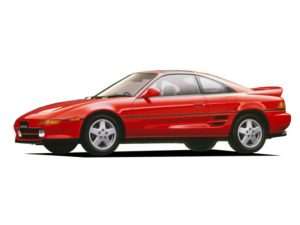
The MR2 Looks Like A Tiny Supercar

The second-generation MR2 arrived in 1989 and immediately abandoned the friendly little shape of the original car.

Instead, Toyota created something that looked like a miniature exotic.

The SW20 is low, wide and wedge-shaped, with the engine sitting behind the occupants. Its 4,170 mm length, 1,695 mm width and 1,235 mm height give it genuine sports-car proportions rather than the inflated dimensions of modern performance cars.

The late cars are particularly attractive.

The 1997–1999 GT-S has the final-generation styling, 15-inch alloy wheels, front spoiler and rear/roof spoiler. The T-Bar version adds removable roof panels, giving the car a completely different character when parked beside ordinary Japanese coupes.

There is also something wonderfully old-fashioned about the pop-up headlights and side air intakes.

Nothing on the road says, “I have purchased the sensible option.”

For Bangladesh, however, the beautiful low stance creates a problem.

The ground clearance is approximately 130 mm.

This is enough for decent roads.

It is not enough for the enormous concrete speed bumps that appear across Dhaka like hostile geological formations.

The body should therefore be inspected extremely carefully. Front bumpers, underbody panels, sills and suspension mounting points can reveal previous abuse.

Rust and accident repairs are also more concerning than a few scratches.

The ideal SW20 is straight, relatively original and free from crude widebody conversions or badly fitted aftermarket parts.

A clean MR2 already has enough attitude.

It does not need a fiberglass costume.

Interior

Two Seats, Low Seating And Almost No Nonsense

The SW20's interior is not luxurious.

It is focused.

You sit low, surrounded by a dashboard designed during the glorious period when Toyota engineers still believed buttons were perfectly acceptable alternatives to touchscreens.

The cabin has two seats, a relatively upright dashboard and good forward visibility through the low windscreen. The driver sits close to the centre of the vehicle, which reinforces the feeling that this is a machine built around the driver rather than passengers.

The late GT-S received useful equipment including full-auto air-conditioning, power windows, central locking, tilt steering and a leather-wrapped steering wheel.

But there is no rear bench.

Obviously.

There is also no enormous centre console, no modern digital dashboard and no giant tablet dominating the cabin.

The simplicity is actually refreshing.

In Bangladesh, the biggest interior challenge is age. Plastics, switches, seals, seat fabric and dashboard components have had decades to deteriorate. T-Bar cars need additional inspection because the roof panels and seals can develop leaks.

Storage is also limited compared with a conventional sedan, although the SW20 does provide luggage space around the front and rear compartments.

For daily Bangladesh use, a discreet Bluetooth audio upgrade, USB charger and reverse camera can improve usability.

Just don't turn the cabin into a Dhaka aftermarket electronics showroom.

The MR2's interior works because it is simple.

Keep it that way.

Features

Toyota Chose The Engine Over The Gadget List

The MR2's feature list is almost comically simple by 2026 standards.

And that is partly why enthusiasts like it.

The late GT-S came with full-auto air-conditioning, power windows, central locking, power steering, tilt steering, leather steering wheel, 15-inch alloy wheels, front fog lamps and rear spoiler, while navigation was optional and many modern electronic features simply did not exist.

The important equipment is mechanical.

Toyota gave the turbo model a 5-speed manual transmission, limited-slip differential, mid-engine layout, independent suspension and ventilated disc brakes front and rear.

That is the sort of feature list that makes sense on a sports car.

There is no Apple CarPlay.

There is no Android Auto.

There is no wireless charging.

There is no adaptive cruise control.

There is no 360-degree camera.

And there certainly isn't an app telling you whether the car is currently feeling emotionally fulfilled.

For Bangladesh, sensible upgrades are simple.

Install a quality Bluetooth head unit if needed. Add a reverse camera if desired. Upgrade the headlights carefully. Use modern tyres with correct specifications. Refresh suspension bushes and brake components.

Do not chase enormous wheels.

Do not fit ridiculous exhaust systems.

And don't replace the entire dashboard with a giant tablet.

The MR2 is already interesting because of what is underneath it.

The best modification is usually making sure those 25-year-old mechanical components work properly.

Safety

Strong Basics, Ancient By Modern Standards

The SW20's safety equipment was reasonable for its period, but modern buyers need to understand how old the underlying technology is.

The late GT-S came with driver and passenger airbags, ABS and side-impact bars as standard. Toyota's catalogue specifically lists side airbags, traction control, Brake Assist, EBD and rear-seat safety equipment as unavailable.

That is a very different safety philosophy from a modern Toyota.

There is no automatic emergency braking.

There is no adaptive cruise control.

There is no lane-keeping assistance.

There is no blind-spot monitoring.

There is no traffic-sign recognition.

There is no rear cross-traffic warning.

And there is no curtain-airbag system protecting occupants.

The MR2's safety advantage comes partly from its compact, rigid sports-car construction and excellent handling rather than electronic intervention. Toyota's own historical material describes the SW20's high-rigidity lightweight body and structural reinforcement around suspension mounting areas.

But physics remains physics.

A 1997 sports car does not become a 2026 sports car because someone installed a touchscreen.

For Bangladesh buyers, tyres and brakes are especially important. The GT-S has substantial performance, and old or poor-quality tyres can dramatically reduce the car's safety margin in rain.

Inspect ABS operation, brake discs, suspension, steering components, airbags and chassis condition.

Most importantly, determine whether the car has been crashed or structurally modified.

A properly maintained original SW20 is one thing.

A 1990s MR2 that has been converted, turbo-swapped, widened and driven aggressively for 20 years is an entirely different proposition.

Driving Experience

This Is Where The MR2 Becomes Special

The numbers are already interesting.

The late GT-S has a 2.0L 3S-GTE producing 245 PS and 304 Nm, weighs roughly 1,270kg, uses a five-speed manual and drives the rear wheels through a mid-engine layout.

But numbers do not explain why the SW20 has such a following.

The engine sits behind the driver.

That dramatically changes the car's character.

Turn the steering wheel and the front responds immediately. Apply throttle exiting a corner and the rear tyres become part of the conversation.

It feels alive.

The turbocharged 3S-GTE provides strong acceleration, with period performance figures around the six-second region to 100 km/h depending on test methodology. The engine's 304 Nm torque arrives at 4,000 rpm, giving the car serious punch for its weight.

On a good Bangladesh highway, it is enormous fun.

In Dhaka traffic, the situation is rather less heroic.

The low ride height makes speed breakers irritating. The manual gearbox becomes tiring in congestion. The turbo engine is wasted crawling behind buses.

And then there is the rain.

A mid-engine, rear-wheel-drive sports car with old tyres is not something you should throw around on a wet road simply because you watched a few drifting videos.

A healthy car with quality tyres is much more predictable.

Fuel economy is reasonable for the performance: roughly 6–7.5 km/L in city traffic, 9–11 km/L highway and 7–9 km/L combined is a sensible Bangladesh expectation.

The MR2's magic is not straight-line speed.

It is the combination of light weight, steering response, manual control and mid-engine balance.

That makes it special.
EXPLORE THE RANGE

Variants

G, G-Limited, GT And GT-S

The SW20 range changed substantially throughout its production life.

Toyota offered naturally aspirated G and G-Limited versions, while the turbocharged range included GT and GT-S. T-Bar roof versions were also available. Toyota's catalogue confirms that the turbo cars used the 3S-GTE, while naturally aspirated versions used the 3S-GE.

The early turbo cars produced around 225 PS, while later versions received the final 3S-GTE specification producing 245 PS and 304 Nm.

The late GT-S is the serious enthusiast version.

It combines the 245 PS engine with a five-speed manual, limited-slip differential, high-grip tyres and sport-focused suspension equipment. Toyota specifically describes Bilstein dampers and high-grip tyres as standard on turbo models.

The GT is another turbo option, with a somewhat broader equipment package.

The naturally aspirated G/G-Limited versions are less powerful but can be easier to live with.

For Bangladesh, the choice should depend on the intended use.

A clean NA G-Limited may be a sensible enthusiast car for someone who wants the SW20 chassis without turbo complexity.

A genuine late GT-S is the one to have if performance is the priority.

But the most important word is genuine.

Because the SW20 has been modified extensively around the world, buyers should verify engine code, chassis number, gearbox, turbo hardware and original specification.

A factory GT-S in good condition is one thing.

A tired G converted into a “GT-S” by a local workshop is something else entirely.

The SW20 is now a classic.

Treat it like one, inspect it like one and buy the condition — not merely the badge.
TRENDING

Trending Toyota Cars

View All Toyota Cars
FAQ

Toyota MR2 (1990-1999) Questions & Answers

Toyota MR2 SW20 (1990-1999) price in Bangladesh is approximately Tk 12–25 lakh, depending on model year, engine, GT/GT-S/G grade, T-Bar roof, condition, modifications and documentation.

View All Toyota MR2 (1990-1999) FAQs
📍

Find Dealers Near You

Looking for Toyota MR2 (1990-1999) ? We will notify you when verified dealers become available.

💳

Calculate Your Car EMI

Estimate your monthly payment for Toyota MR2 (1990-1999)

৳ 30,00,000
৳5L ৳1Cr
৳ 5,00,000
৳0 ৳30L
9%
5% 18%
5 Years
1 Year 7 Years
Your Monthly EMI ৳ 64,250 Estimated payment per month
Principal Amount ৳ 30,00,000
Total Interest ৳ 7,68,000
Total Payment ৳ 37,68,000