3.5 Expert Rating

Toyota Land Cruiser J100 (1998-2007) Expert Review

Extensively tested and reviewed by Team CarHub

EXPERT VERDICT
"
Toyota Land Cruiser 100 remains a remarkably capable, durable and comfortable 4WD, but its age and fuel consumption demand careful ownership.
AT A GLANCE

Pros & Cons

✓
WHAT WE LIKE

Good Things

  • ✓
    Exceptional durability
  • ✓
    Genuine off-road ability
  • ✓
    Spacious family cabin
  • ✓
    Strong resale demand
−
WHAT COULD BE BETTER

Could Be Better

  • −
    Extremely high fuel consumption
  • −
    Expensive maintenance parts
  • −
    Very large dimensions
  • −
    Outdated safety technology
Toyota Land Cruiser J100 (1998-2007)
— 35 Reviews
৳ 13.00 Lakh - 50.00 Lakh

Exterior

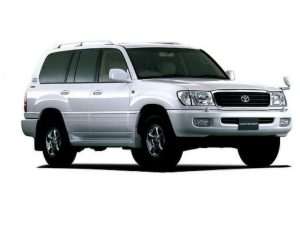
The Land Cruiser 100 does not need an introduction. It arrives looking like it has just returned from somewhere unpleasant and is perfectly prepared to go back. Introduced in 1998 as the successor to the legendary 80 Series, the 100 Series grew larger and more luxurious while retaining the separate-frame architecture and serious four-wheel-drive hardware that made the Land Cruiser name famous. Toyota itself describes the 100 as combining improved 4WD performance with a more prestigious luxury image. At roughly 4.89 metres long, 1.94 metres wide and 1.86 metres tall, it is a substantial vehicle. In Bangladesh, that size has two personalities. On a highway, it feels reassuringly enormous. On a narrow Dhaka street, it feels like someone has attempted to drive a small apartment through a vegetable market. The approximately 220mm ground clearance is excellent for Bangladesh. Broken roads, deep potholes, speed breakers and rough rural surfaces are considerably less intimidating than they are in a low sedan. The design itself has aged remarkably well. The upright grille, squared body, large windows and simple lighting do not scream “1998” in the way many contemporary SUVs do. The later facelift cars look even cleaner and more modern. VX Limited and Cygnus versions can add larger alloy wheels, roof rails, sunroof equipment, premium lighting and more luxurious exterior trim. The real attraction, however, is not styling. It is the visual promise that the vehicle could probably drive through a wall. And unlike many SUVs that merely look tough, the Land Cruiser 100 actually can.

Interior

Inside, the Land Cruiser 100 demonstrates how Toyota gradually transformed the Land Cruiser from agricultural machinery into a luxury family SUV without completely destroying its rugged character.

The cabin is enormous.

The high seating position provides excellent visibility, while the broad dashboard and generous shoulder room make long-distance journeys comfortable.

Depending on specification, buyers can find leather upholstery, electric seats, automatic climate control, premium audio, sunroof equipment, wood-effect trim and other luxury touches.

The premium Cygnus specification pushed the formula even further, essentially creating a Japanese-market luxury version of the 100 Series.

The seating configuration varies by market, but eight-seat versions are common in Japanese specifications.

Cargo space is also useful, especially with the rear seats folded.

The biggest weakness is obvious.

This is an old vehicle.

The dashboard technology looks ancient next to a modern Toyota. Factory navigation, where fitted, is now largely obsolete. There is no Apple CarPlay, Android Auto, wireless charging or modern smartphone integration.

Fortunately, the 100 Series is one of those vehicles that responds beautifully to aftermarket upgrades.

A modern Android head unit, reverse camera, parking sensors, Bluetooth and USB charging can dramatically improve daily usability.

The important thing is that the basic cabin architecture remains excellent.

The seats are comfortable, visibility is strong and the cabin feels substantial.

For Bangladesh family use, the Land Cruiser 100's interior is still one of its strongest qualities.

It just needs a little help from the twenty-first century.

Features

The feature list of the Land Cruiser 100 depends heavily on where and when the vehicle was built.

Early versions were relatively straightforward.

Later VX Limited and Cygnus versions could be remarkably luxurious, with automatic climate control, power seats, leather interiors, sunroof, navigation, premium audio, cruise control, rear entertainment equipment and reversing-camera systems depending on specification.

This creates an important problem for Bangladesh buyers.

Two Land Cruiser 100s parked next to each other can look almost identical while having dramatically different equipment.

One may have manual seats and basic audio.

The other may have electric leather seats, navigation, sunroof and a factory rear entertainment system.

And then there are the aftermarket cars.

Bangladesh has plenty of older Land Cruisers fitted with Android screens, LED lights, reverse cameras, parking sensors and Lexus-style body modifications.

There is nothing inherently wrong with this.

But CarHub should distinguish factory equipment from aftermarket equipment.

The original 100 Series was technologically advanced for its era but is obviously primitive compared with a 2026 SUV.

There is no factory Apple CarPlay, Android Auto, adaptive cruise control, autonomous emergency braking or lane-keeping system.

The important features are mechanical rather than digital.

Full-time 4WD, low-range gearing, robust suspension, a strong chassis and a large fuel tank matter far more when the road suddenly disappears.

That is why the Land Cruiser 100 remains valuable.

Its most important technology is the stuff you cannot see on the dashboard.

Safety

The Land Cruiser 100 was reasonably well equipped for its era, but its safety technology needs to be judged in historical context.

Depending on grade, the vehicle can have dual front airbags, ABS, EBD, traction control, stability control, side airbags and curtain airbags.

Higher-grade versions such as the Japanese-market Grande/Cygnus received substantially more safety equipment than basic versions. ANCAP's period testing also demonstrates that safety equipment varied between grades and safety packages.

The large body, substantial chassis and high seating position provide a strong sense of security.

But modern safety is a different game.

There is no factory autonomous emergency braking.

No adaptive cruise control.

No lane-keeping assistance.

No blind-spot monitoring.

No traffic-sign recognition.

No automatic high-beam assistance.

So while the Land Cruiser 100 can still be a robust vehicle, it does not provide the active collision-avoidance technology available in modern Toyota SUVs.

Condition is equally important.

A twenty-year-old Land Cruiser with worn tyres, damaged airbags, tired suspension or a poorly repaired chassis is not made safe by its reputation.

Before buying one in Bangladesh, inspect the chassis, brakes, airbags, ABS system, tyres, suspension and steering.

The old Land Cruiser's greatest safety advantage is its physical robustness.

Its greatest safety weakness is that its technology belongs to another era.

Driving Experience

The 4.7-litre 2UZ-FE V8 is the mechanical heart of the Land Cruiser 100. And it is exactly the sort of engine you would expect Toyota to put into something weighing well over two tonnes. It is not frantic. It is effortless. The V8 produces around 235 hp and 434 Nm, sending power through an automatic transmission and permanent 4WD. Toyota initially paired the 4.7L engine with a four-speed automatic, upgrading to a five-speed automatic in 2002. The engine is smooth and muscular rather than sporty. Press the accelerator and the Land Cruiser gathers speed with the calm determination of something that knows it has all day. The official technical data gives approximately 11.2 seconds to 100 km/h and 180 km/h maximum speed for the petrol configuration. But acceleration is not the reason people buy it. The real magic is the ride. The suspension absorbs poor surfaces with impressive composure, while the permanent 4WD system gives excellent traction. In Bangladesh, this makes the Land Cruiser unusually versatile. It can cruise Dhaka-Chattogram Highway comfortably, tackle broken rural roads, handle muddy surfaces and deal with flood-affected routes far better than most ordinary SUVs. The problem is fuel. A 4.7L V8 is not interested in your fuel budget. Expect around 4.5–6 km/L in heavy city traffic, perhaps 7–9 km/L on highways, and roughly 5.5–7 km/L combined in realistic Bangladesh use. That makes fuel cost the single biggest drawback. But if you can afford the fuel, the driving experience remains exceptional. It is heavy, calm, capable and reassuring. It feels less like driving a car and more like operating a very comfortable piece of infrastructure.
EXPLORE THE RANGE

Variants

The Land Cruiser 100 range was considerably broader than a simple “4.7 V8” label suggests. The major engine choices included the 4.7L 2UZ-FE V8 petrol and, in many markets, the 4.2L 1HD-FTE turbo-diesel six-cylinder. Toyota's historical data confirms both engines in the 100 Series. For the petrol range, grades included versions such as VX, VX Limited and Cygnus, with equipment varying according to market and production year. The VX was the core luxury 4WD. VX Limited added considerably more equipment and comfort. Cygnus was the premium Japanese-market version and is closely associated with the Lexus LX 470 mechanically and structurally. The transmission also changed during the generation. Early 4.7L models used a four-speed automatic, while Toyota introduced a five-speed automatic from 2002. For Bangladesh, the 4.7L V8 is particularly attractive to buyers who prioritise smoothness and long-term durability, while diesel versions can make more sense for people concerned about fuel consumption and long-distance running. The important point is that a Land Cruiser 100 should never be purchased purely by year or badge. The actual engine, grade, drivetrain, suspension specification, service history and condition matter enormously. A clean VX Limited with a healthy drivetrain is a very different proposition from a neglected base-spec car wearing expensive wheels. Overall, the Land Cruiser 100 remains one of the most convincing old-school luxury 4WDs available in Bangladesh. It is spacious, tough, comfortable and genuinely capable. But there is one unavoidable condition attached to ownership: You must be prepared to feed the V8.
TRENDING

Trending Toyota Cars

View All Toyota Cars
FAQ

Toyota Land Cruiser J100 (1998-2007) Questions & Answers

Toyota Land Cruiser J100 price in Bangladesh is currently around Tk 13–50 lakh for used 1998–2007 models, particularly 4.7L V8 VX, VX Limited and Cygnus versions. Current public listings show some 4.7L Cygnus cars around Tk 30–50 lakh, although individual asking prices can be higher depending on condition and originality.

View All Toyota Land Cruiser J100 (1998-2007) FAQs
📍

Find Dealers Near You

Looking for Toyota Land Cruiser J100 (1998-2007) ? We will notify you when verified dealers become available.

💳

Calculate Your Car EMI

Estimate your monthly payment for Toyota Land Cruiser J100 (1998-2007)

৳ 30,00,000
৳5L ৳1Cr
৳ 5,00,000
৳0 ৳30L
9%
5% 18%
5 Years
1 Year 7 Years
Your Monthly EMI ৳ 64,250 Estimated payment per month
Principal Amount ৳ 30,00,000
Total Interest ৳ 7,68,000
Total Payment ৳ 37,68,000