5.0 Expert Rating

Toyota Harrier (2003-2013) Expert Review

Extensively tested and reviewed by Team CarHub

EXPERT VERDICT
"
Toyota Harrier remains a comfortable, reliable luxury SUV with strong road presence, but age, fuel consumption and outdated technology now matter.
AT A GLANCE

Pros & Cons

✓
WHAT WE LIKE

Good Things

  • ✓
    Comfortable spacious cabin
  • ✓
    Strong Toyota reliability
  • ✓
    Good ride quality
  • ✓
    Useful cargo space
−
WHAT COULD BE BETTER

Could Be Better

  • −
    High fuel consumption
  • −
    Aging safety technology
  • −
    Four-speed automatic feels dated
  • −
    Expensive older examples
Toyota Harrier (2003-2013)
— 35 Reviews
৳ 13.00 Lakh - 30.00 Lakh

Exterior

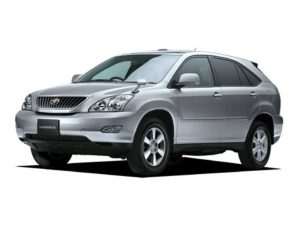
The second-generation Toyota Harrier arrived at a time when SUVs were still trying to decide whether they wanted to be rugged off-road machines or luxury cars wearing hiking boots. Toyota's answer was wonderfully simple: make the SUV look like a luxury car. The XU30 Harrier has a long, wide body with a relatively low roofline, smooth body sides and a substantial front end. At roughly 4,735mm long and 1,845mm wide, it has genuine road presence without looking like a giant American truck. The design has aged surprisingly well. Park one beside a small modern crossover and the Harrier still looks like it belongs in a more expensive neighbourhood. Higher grades add larger alloy wheels, HID headlights, sunroof or moonroof options, roof/rear spoilers and chrome detailing. The AIRS and Premium L Package versions can look particularly upmarket. For Bangladesh, the size is both an advantage and a nuisance. It gives the driver a commanding view over traffic, but squeezing the Harrier through a narrow Dhaka lane requires considerably more concentration than driving an Axio. The approximately 185mm ground clearance is respectable for Bangladesh, although age matters. A Harrier with tired suspension or oversized aftermarket wheels can behave very differently from a factory-fresh example. The exterior's greatest strength is that it still looks expensive. Its greatest weakness is that many examples in Bangladesh have been modified, repainted or cosmetically upgraded over the years. Judge the actual car, not the shiny grille.

Interior

Inside, the Harrier explains why Toyota marketed this car as a luxury SUV rather than simply a larger RAV4. The cabin is spacious, comfortable and deliberately more sophisticated than the typical Toyota of its era. The dashboard uses soft-looking materials, wood-style trim appears on higher grades, and leather upholstery and power seats were available on better-equipped versions. The driving position is upright without feeling like you are sitting on top of the car. The rear bench is one of the Harrier's strengths. There is useful legroom for adults, and the rear seats fold to dramatically increase luggage capacity. Boot capacity is around 440 litres with the seats up, making the Harrier genuinely useful for family travel rather than merely fashionable. The equipment, however, tells you immediately which decade this car came from. Factory navigation systems used DVD or HDD media, Bluetooth was not universal, and modern smartphone integration simply did not exist. Many Bangladesh examples therefore have aftermarket Android screens, cameras and audio systems. That can be perfectly sensible, provided the installation is good. The biggest interior problem today is not the design but age. Buttons become worn, leather cracks, power seats stop working and electrical accessories can develop faults. A well-preserved Harrier still feels premium. A neglected one can feel like a 15-year-old executive lounge whose receptionist has stopped answering the phone.

Features

The Harrier was unusually well equipped for its time. Toyota offered features that would have looked distinctly luxurious when this generation launched, including automatic climate control, power seats, leather steering wheels, navigation, sunroof or moonroof options, HID headlights, cruise control on selected versions, rear cameras and premium audio systems.

Higher grades such as the 240G L Package and Premium L Package could add considerably more equipment, while AIRS versions pushed the luxury theme even further. Factory navigation systems could use DVD or HDD media, and some versions offered sophisticated multi-information displays.

The trouble is that “feature-rich” and “modern” are not the same thing.

There is no Apple CarPlay, Android Auto, wireless phone charging or modern connected-car ecosystem from the factory. If a Bangladesh Harrier has a giant Android touchscreen, 360-degree camera or wireless charging pad, there is a good chance somebody added it later.

That is not necessarily bad. In fact, a properly installed Android head unit can make an old Harrier much easier to live with.

But buyers should distinguish factory equipment from aftermarket equipment.

The genuinely useful original features are still useful today: automatic AC, power seats, comfortable rear seating, cruise control on equipped cars, sunroof, HID headlights, rear camera and good storage.

The Harrier's technology has aged; its practical equipment has not.

That is probably the nicest thing you can say about a 20-year-old luxury SUV

Safety

The second-generation Harrier was reasonably well protected for its era, but this is where time has been particularly unkind.

Toyota provided ABS, brake assist and EBD, while driver and passenger airbags were standard. Side airbags were available on some grades, and higher specifications could have additional protection equipment. Toyota also included seat-belt pretensioners, three-point rear belts and an immobilizer/security system.

Some versions also offered traction and stability-related systems, but equipment varied significantly by grade and year. Buyers should therefore verify the exact chassis and factory equipment rather than assuming every Harrier has the same safety package.

The real-world advantage is that the Harrier is a substantial vehicle with a strong body structure and predictable braking. The front ventilated discs and rear discs provide respectable stopping hardware for the period.

But there is no getting around the elephant in the room: this generation predates modern ADAS.

There is no factory Toyota Safety Sense, autonomous emergency braking, lane-keeping assistance, adaptive cruise control or traffic-sign recognition. A modern 360-degree camera or collision-warning system found in a Bangladesh example is likely aftermarket.

That does not make the Harrier unsafe. It makes it an older vehicle.

For a used buyer, condition matters enormously. Tyres, brake condition, suspension, airbags and structural accident repairs can have a much larger impact on real-world safety than the equipment list.

A clean, properly maintained Harrier is reassuring. A badly repaired one is not.

Driving Experience

The Harrier does not drive like a sports SUV, and anyone expecting it to will be disappointed before reaching the first traffic light.

The popular 2.4L 2AZ-FE produces 160 hp and 221 Nm, which sounds perfectly respectable until you remember that this is a fairly large SUV carrying around 1.6 tonnes in front-wheel-drive form and more in four-wheel-drive versions.

Acceleration is adequate rather than thrilling. Depending on drivetrain and testing method, 0–100 km/h is roughly 10.5–12.4 seconds. The four-speed automatic is smooth enough but noticeably old-fashioned by modern standards.

In Dhaka, however, nobody cares about Nürburgring lap times when the road ahead contains a bus, three CNGs, a rickshaw and a pedestrian who has apparently chosen immortality.

The Harrier's real strengths are comfort and refinement.

The suspension is soft enough to deal with ordinary broken Bangladeshi roads without turning every pothole into a personal insult. The high seating position provides good visibility, and the cabin remains comfortable on longer trips.

On highways, the 2.4L engine cruises adequately, although overtaking requires more planning than in the 3.5L V6. The V6 versions are much faster but come with considerably higher fuel consumption.

For everyday Bangladesh driving, the 2.4L is the sensible choice.

It is not exciting.

It is comfortable, dependable and sufficiently quick—which is exactly what most Harrier owners actually want.
EXPLORE THE RANGE

Variants

The second-generation Harrier's variant range is considerably broader than many Bangladesh buyers realise.

The main petrol family includes 240G, 240G L Package and 240G Premium L Package, while larger engines brought the 300G and 350G families. Toyota also offered luxury-oriented AIRS versions, while the Harrier Hybrid existed separately with its own powertrain and equipment.

For Bangladesh, the 240G and 240G L Package are the easiest recommendations. The 2.4L engine offers reasonable running costs for a large older SUV, and the four-speed automatic is mechanically straightforward.

The Premium L Package is attractive if you want more luxury equipment such as better interior trim, power seats, navigation and sunroof-related equipment. The 300G and 350G provide substantially stronger performance, but fuel consumption becomes a serious consideration in Bangladesh.

AIRS models are interesting collector-style purchases because of their luxury equipment and air-suspension technology, but that sophistication can become a liability when the vehicle is 15–20 years old.

The most important advice is therefore simple: buy condition, not badge or grade.

A beautifully maintained 240G is a much better purchase than a neglected Premium L Package with questionable accident history.

For most Bangladesh buyers, a clean 2.4L 240G or 240G L Package with verified history, healthy suspension, good AC and an unmolested drivetrain is the Harrier sweet spot.
TRENDING

Trending Toyota Cars

View All Toyota Cars
FAQ

Toyota Harrier (2003-2013) Questions & Answers

Toyota Harrier (2003-2013) price in Bangladesh currently ranges from around Tk 13 lakh to Tk 30 lakh for 2003–2013 used cars. Older 2003–2006 models generally sit around Tk 13–19 lakh, while cleaner 2009–2012 models can reach around Tk 25–30 lakh. price depends heavily on mileage, grade, registration year, accident history, interior condition and whether the vehicle has expensive factory options such as sunroof, leather seats and power seats.

View All Toyota Harrier (2003-2013) FAQs
📍

Find Dealers Near You

Looking for Toyota Harrier (2003-2013) ? We will notify you when verified dealers become available.

💳

Calculate Your Car EMI

Estimate your monthly payment for Toyota Harrier (2003-2013)

৳ 30,00,000
৳5L ৳1Cr
৳ 5,00,000
৳0 ৳30L
9%
5% 18%
5 Years
1 Year 7 Years
Your Monthly EMI ৳ 64,250 Estimated payment per month
Principal Amount ৳ 30,00,000
Total Interest ৳ 7,68,000
Total Payment ৳ 37,68,000