4.5 Expert Rating

Toyota Fortuner (2015-2020) Expert Review

Extensively tested and reviewed by Team CarHub

EXPERT VERDICT
"
Toyota Fortuner is a rugged, dependable seven-seat SUV with strong diesel torque, excellent road clearance.
AT A GLANCE

Pros & Cons

✓
WHAT WE LIKE

Good Things

  • ✓
    Excellent Toyota reliability
  • ✓
    Strong diesel torque
  • ✓
    Excellent ground clearance
  • ✓
    Genuine seven-seat practicality
−
WHAT COULD BE BETTER

Could Be Better

  • −
    Expensive purchase price
  • −
    Heavy and bulky
  • −
    Average fuel economy
  • −
    Firm ride quality
Toyota Fortuner (2015-2020)
— 39 Reviews
৳ 55.00 Lakh - 1.20 Crore

Exterior

A Proper SUV Rather Than a Tall Hatchback

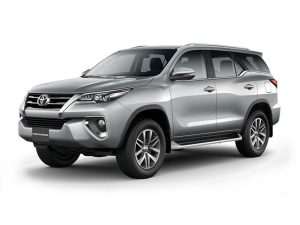
The Fortuner's exterior design has always understood one important thing: a seven-seat SUV should look like it could survive a disagreement with a Bangladeshi pothole.

The 2015–2020 generation became noticeably more sophisticated than the old Fortuner while retaining the upright stance that buyers wanted. The long bonnet, high shoulder line, large grille and substantial wheel arches give it genuine road presence. In Dhaka traffic, that matters because the Fortuner is visually difficult to ignore.

At roughly 4.8 metres long and 1.85 metres wide, it is a sizeable machine. The high ground clearance is particularly useful in Bangladesh, where speed breakers sometimes appear to have been designed by people with a personal grudge against low cars.

Higher grades received larger alloy wheels, roof rails, LED lighting elements, chrome detailing and more elaborate exterior equipment. TRD Sportivo versions add a more aggressive appearance.

The styling is not delicate, nor is it supposed to be. It communicates durability rather than fashion.

The downside is size. Narrow roads, crowded markets and tight Dhaka parking spaces can make the Fortuner feel considerably larger than a typical family sedan.

Overall, the exterior remains one of the Fortuner's strongest selling points. It looks expensive, tough and capable without becoming unnecessarily extravagant. For more visual detail, open the detailed image gallery. The full specifications and features gives the key dimensions and exterior equipment in one place.  Toyota Fortuner  stands out through the combination of its proportions, lighting and wheel package, which matter when choosing a car you will see every day.

Interior

Spacious, Practical and Built for Long-Term Abuse

Inside, the Fortuner takes a very different approach from a luxury SUV. It prioritises durability and usability over decorative theatre.

The driving position is commanding, with excellent visibility and a naturally high seating position. The front seats are comfortable enough for long journeys, while the second row provides useful space for adults. The third row is practical when required but is better suited to children or shorter trips.

The dashboard design of this generation was a significant improvement over earlier Fortuners. Higher grades could bring leather upholstery, better infotainment, automatic climate control, keyless entry and additional convenience equipment.

Storage is another strength. There are numerous practical compartments, cup holders and spaces for everyday items, making the cabin suitable for family use.

But this is where expectations need controlling. A Fortuner can cost serious money in Bangladesh, yet the interior does not always feel as expensive as its price suggests. Some plastics are hard, the design can feel utilitarian and luxury touches are noticeably behind premium European SUVs.

The third row also compromises luggage space. With seven passengers aboard, the boot becomes rather modest.

Still, the interior succeeds at its primary mission: getting seven people from Dhaka to Cox's Bazar, Sylhet or a village road without making everyone question their life choices.

Features

Useful Technology Rather Than Technology for Technology's Sake

The Fortuner's equipment varies considerably by year, market and grade, so two apparently identical vehicles can have surprisingly different feature lists.

Common useful equipment includes power windows, automatic air-conditioning or climate control, cruise control, keyless entry, push-button start, parking sensors, touchscreen infotainment, Bluetooth connectivity, USB connectivity and steering-wheel controls.

Higher grades add better lighting, larger wheels, leather upholstery, additional cameras and more sophisticated convenience equipment.

What the Fortuner does particularly well is provide features that actually matter in Bangladesh. Rear air-conditioning is important when seven people are travelling through Dhaka in summer. Parking sensors are valuable because this is a large SUV. Cruise control becomes useful on longer highway journeys.

Where it begins to show its age is connected technology. Modern Fortuners offer far more smartphone integration and advanced driver assistance, while many 2015–2020 examples lack Android Auto, Apple CarPlay and modern connected services.

It also lacks some features that buyers might expect from an expensive SUV, such as a panoramic sunroof, wireless charging or sophisticated semi-autonomous driving functions.

But perhaps that simplicity is part of its appeal. There is less electronic theatre and more conventional mechanical hardware.

For a Bangladesh buyer, I would rather have a healthy 2.8 diesel Fortuner with working AC and 4WD than a spectacular feature list attached to a questionable vehicle.

Safety

Strong Fundamentals, But Not a Modern ADAS Specialist

Safety was one of the Fortuner's stronger areas for its era. Depending on grade, the vehicle can be equipped with multiple airbags, ABS, EBD, Brake Assist, traction control, stability control, hill-start assistance and hill-descent control. The high driving position also provides a useful view over traffic. That is particularly valuable in Bangladesh, where motorcycles, CNGs, rickshaws, buses and pedestrians frequently occupy the same piece of road with absolutely no interest in forming an orderly queue. Higher grades can provide additional parking assistance and cameras, although equipment varies considerably between imported versions. The underlying ladder-frame construction and substantial size provide confidence, but buyers should not confuse physical bulk with unlimited safety. A heavy SUV still needs good tyres, functioning brakes and properly maintained suspension. The biggest weakness is the age of the platform's driver-assistance technology. Modern Fortuners can have advanced Toyota safety systems, but many 2015–2020 examples do not have today's full suite of adaptive cruise control, lane-keeping assistance, automatic emergency braking and traffic-sign recognition. For a used Bangladesh-market Fortuner, condition is therefore crucial. A neglected example with worn tyres and poorly repaired accident damage can be much less safe than a properly maintained lower-grade vehicle. The fundamentals are strong; the technology is simply from another era. For the complete equipment breakdown, see the full safety review and the full specifications and features. The full features review puts the safety kit alongside the rest of the vehicle's technology, while the driving experience review explains how the car behaves on the road. You can also browse the detailed image gallery, owner reviews, and all variants . These details give the Toyota Fortuner a clearer safety picture for everyday use.

Driving Experience

Strong Torque, High Driving Position and Surprisingly Capable Off Road

The 2.8-litre diesel is the engine that gives the Fortuner its personality. With around 180 hp and 450 Nm in this generation, it has enough torque to move the large SUV with authority.

It is not a sports car. Nobody should buy a seven-seat ladder-frame SUV expecting it to behave like a Porsche. But the strong low- and mid-range torque makes overtaking and climbing difficult roads straightforward.

In Dhaka traffic, the automatic transmission is considerably easier to live with than a manual. The high driving position provides excellent visibility, while the suspension handles broken surfaces better than many conventional crossovers.

Ride quality, however, is not luxurious. The Fortuner's body-on-frame construction means sharp bumps can be felt, particularly when the vehicle is lightly loaded. Once passengers and luggage are aboard, the ride settles down.

On highways, the character changes. It becomes stable, relaxed and very good at covering long distances. The diesel engine settles into its work and the large fuel tank gives useful range.

The 4WD system is the real party trick. For rural Bangladesh, muddy roads, steep surfaces and poor-weather conditions, genuine 4WD is considerably more useful than a fashionable crossover with decorative SUV styling.

Fuel economy is the unavoidable price. Around 7–8.5 km/L in Dhaka and 10–12 km/L on highways is realistic for a healthy 2.8 diesel.
EXPLORE THE RANGE

Variants

Which Fortuner Makes the Most Sense?

The Fortuner range between 2015 and 2020 is complicated because engine and grade availability varied by country. The major choices relevant to buyers are the 2.7-litre petrol, 2.4-litre diesel and 2.8-litre diesel, with equipment and drivetrain configurations varying between markets. Higher grades such as V and TRD Sportivo generally brought additional styling and equipment. For Bangladesh, the 2.8 diesel automatic is arguably the most attractive overall configuration. Its 450 Nm of torque, six-speed automatic transmission and available 4WD suit the country's mixture of congested cities, highways and rougher regional roads extremely well. The 2.7 petrol makes more sense for buyers who prioritise petrol refinement and do not drive enough kilometres to justify a diesel. It is smoother but does not deliver the same low-speed pulling power. The 2.4 diesel is economical and practical, but the 2.8 is the more convincing engine when the Fortuner is heavily loaded or driven outside the city. Higher TRD Sportivo versions appeal to buyers who want additional styling and equipment, although they command a premium. My overall choice would be a well-maintained 2.8 diesel automatic with genuine 4WD, rather than buying a higher trim purely for appearance. A clean, mechanically healthy Fortuner is worth considerably more than a shiny example with a questionable history.
TRENDING

Trending Toyota Cars

View All Toyota Cars
FAQ

Toyota Fortuner (2015-2020) Questions & Answers

A used Toyota Fortuner 2015–2020 generally costs around Tk 55 lakh to Tk 1.20 crore in Bangladesh. Older 2015 models can be substantially cheaper, while clean 2018–2020 2.8 diesel 4WD vehicles can approach or exceed the Tk 1 crore mark. Actual price depends heavily on mileage, grade, import history, accident history and maintenance condition.

View All Toyota Fortuner (2015-2020) FAQs
📍

Find Dealers Near You

Looking for Toyota Fortuner (2015-2020) ? We will notify you when verified dealers become available.

💳

Calculate Your Car EMI

Estimate your monthly payment for Toyota Fortuner (2015-2020)

৳ 30,00,000
৳5L ৳1Cr
৳ 5,00,000
৳0 ৳30L
9%
5% 18%
5 Years
1 Year 7 Years
Your Monthly EMI ৳ 64,250 Estimated payment per month
Principal Amount ৳ 30,00,000
Total Interest ৳ 7,68,000
Total Payment ৳ 37,68,000