4.5 Expert Rating

Toyota Corolla E100 (1991-1995) Expert Review

Extensively tested and reviewed by Team CarHub

EXPERT VERDICT
"
Toyota Corolla E100 is a simple, dependable and economical old-school sedan, ideal for budget-conscious Bangladesh buyers who value durability over modern features.
AT A GLANCE

Pros & Cons

✓
WHAT WE LIKE

Good Things

  • ✓
    Excellent Toyota reliability
  • ✓
    Cheap maintenance
  • ✓
    Good fuel economy
  • ✓
    Simple mechanical design
−
WHAT COULD BE BETTER

Could Be Better

  • −
    Very outdated safety
  • −
    Weak modern performance
  • −
    Basic interior technology
  • −
    Age-related maintenance
Toyota Corolla E100 (1991-1995)
— 45 Reviews
৳ 3.50 Lakh - 7.00 Lakh

Exterior

Design & Build Quality

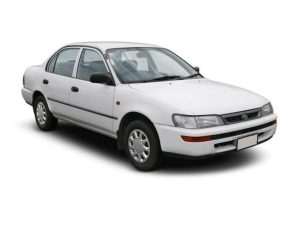
The Corolla E100 is from an era when Toyota apparently believed that a car's job was to be useful rather than become an Instagram celebrity.

And honestly, that is why it has aged reasonably well.

The shape is simple: four doors, three-box sedan proportions, relatively upright glass and clean body lines. There is nothing aggressive about it. No giant grille. No fake vents. No attempt to make a 1.5-litre family sedan look like a racing car.

In Bangladesh, that understatement actually works. The Corolla 100 has become familiar enough to disappear into traffic, which is useful when you don't want your car attracting attention. It also has relatively compact dimensions at 4,275mm long and 1,685mm wide, making it much easier to manoeuvre than modern SUVs.

The problem is age.

Finding an original E100 today is becoming increasingly difficult. Many surviving cars have been repainted, fitted with aftermarket bumpers, converted to CNG or modified in ways Toyota's designers never imagined.

A clean, stock example is therefore surprisingly attractive.

It doesn't have the glamour of a modern Corolla.

But it has something arguably more useful:

a shape that simply refuses to go out of fashion because it never tried to be fashionable.

For more visual detail, open the detailed image gallery. The full specifications and features gives the key dimensions and exterior equipment in one place.  Toyota Corolla 1.5 stands out through the combination of its proportions, lighting and wheel package, which matter when choosing a car you will see every day.

Interior

Inside, the E100 is wonderfully uncomplicated.

There is no giant screen staring at you. No digital instrument cluster. No illuminated dashboard. No electronic menu containing seventeen different ways to adjust the air-conditioning.

You get a steering wheel, gauges, switches, seats and an air-conditioning system.

For a modern buyer, that sounds primitive.

For a Bangladesh owner trying to keep a 30-year-old car alive, it sounds rather brilliant.

The dashboard is straightforward and the controls are easy to understand. Higher grades could offer better equipment, including power windows, central locking and automatic air-conditioning. Toyota's SE Limited specification confirms full-auto AC, power windows and central locking.

The seats are comfortable enough for normal city and highway use, although the cabin obviously lacks the refinement and space of a modern Corolla.

The biggest advantage is repairability. There isn't much complicated electronics to fail.

The biggest disadvantage is everything that isn't there.

No modern infotainment.

No smartphone integration.

No sophisticated sound insulation.

No modern safety technology.

Still, if your objective is simply getting from Dhaka to Chattogram without your dashboard having an existential crisis, the E100 remains rather good at its job.

Features

The E100's feature list looks almost comically short beside a modern Corolla.

Depending on grade, buyers could get power steering, power windows, central locking, automatic air-conditioning, tilt steering, optional alloy wheels, fog lamps, sunroof and basic radio/cassette equipment.

And that was about the point where Toyota stopped.

There was no CarPlay because smartphones had barely become a thing. There was no navigation system because nobody expected their car to know where they were. There was certainly no wireless charging.

In Bangladesh, most surviving E100s have therefore been modernised by their owners. Android head units, reverse cameras, Bluetooth audio, USB chargers and aftermarket alarms are common.

Some modifications are genuinely useful.

Others are less so.

A good modern head unit makes sense. A dashboard illuminated like a gaming PC does not.

The E100's greatest feature today is actually its simplicity. The fewer electronic systems a 30-year-old car has, the fewer opportunities there are for something obscure to stop working.

It is not technologically impressive.

It is mechanically honest.

And for an old Bangladesh daily driver, that can be worth more than a touchscreen.

Safety

Safety & Driver Assistance

This is where the E100 stops being charming and starts showing its age.

Modern cars surround occupants with airbags, stability control, autonomous emergency braking, lane assistance, blind-spot monitoring and increasingly sophisticated crash structures.

The E100 does not.

Toyota's Japanese SE Limited specification lists a driver airbag and ABS as optional equipment, while passenger airbags, side airbags, curtain airbags, Brake Assist, EBD and traction control were absent.

That means safety equipment varies considerably between surviving examples.

Some cars may have ABS and a driver's airbag.

Others may have neither.

For Bangladesh buyers, this is one of the strongest arguments for inspecting the actual vehicle rather than assuming the equipment from the model name.

The good news is that the car has predictable mechanical braking and straightforward controls.

The bad news is that physics has moved on.

A 1990s Corolla simply cannot offer the occupant protection of a modern Corolla.

So yes, it can still be a reliable daily car.

But if you have young children or regularly travel at high highway speeds, modern safety should carry much more weight in your buying decision than nostalgia

For the complete equipment breakdown, see the full safety review and the full specifications and features. The full features review puts the safety kit alongside the rest of the vehicle's technology, while the driving experience review explains how the car behaves on the road. You can also browse the detailed image gallery, owner reviews, and all variants. These details give the Toyota Corolla 1.5 a clearer safety picture for everyday use.

Driving Experience

The E100 is not fast.

With roughly 105 PS from its 1.5L 5A-FE, it was never designed to embarrass sports cars. Toyota's own specification confirms 105 PS and 135.3 Nm.

But speed was never the point.

The engine is smooth, uncomplicated and reasonably economical. The automatic gearbox makes city driving easy, while the compact dimensions and roughly 4.8m turning radius are useful in crowded Bangladesh streets.

The ride is relatively soft and forgiving, which works well on ordinary roads.

A healthy example can still feel surprisingly pleasant.

The word healthy is doing enormous work here.

A 30-year-old Corolla with worn suspension, tired engine mounts, weak AC and a neglected automatic transmission will feel completely different from a properly maintained one.

On highways, the 1.5L engine is adequate rather than exciting. Overtaking requires planning, particularly with passengers and air-conditioning running.

But fuel economy is respectable, parts are widely understood by local mechanics and the mechanical architecture is straightforward.

That is why the E100 survived.

It isn't brilliant at anything.

It is simply good enough at almost everything, which is a rather powerful automotive trick.

EXPLORE THE RANGE

Variants

The E100 range varied significantly by market, but the Bangladesh-relevant configuration is overwhelmingly the 1.5L AE100 with the 5A-FE.

Toyota offered multiple 1.5L and 1.6L configurations, while higher-performance Japanese derivatives used engines such as the 4A-GE. Toyota's historical archive confirms the 1.5L 5A-FE at 105 PS alongside the 1.6L 4A-FE and performance-oriented 4A-GE versions.

For Bangladesh, however, there is little reason to chase the rare performance versions unless you are specifically building an enthusiast car.

The 1.5L automatic is the sensible everyday configuration.

The manual is more engaging and mechanically simpler, but automatic E100s are much more representative of the Bangladesh used-car market.

Higher trims such as SE Limited could add useful comfort equipment, while ABS, driver airbags, alloy wheels and sunroofs were often optional rather than universally standard.

My recommendation is therefore simple:

Buy the cleanest, most original 1.5L AE100 you can find—not the cheapest one.

At this age, condition beats trim.

A beautifully maintained basic Corolla is worth considerably more to an owner than a “full-option” example whose gearbox, AC and suspension are all preparing to retire.

TRENDING

Trending Toyota Cars

View All Toyota Cars
FAQ

Toyota Corolla E100 (1991-1995) Questions & Answers

Toyota Corolla E100 price in Bangladesh is approximately Tk 3.5–7 lakh depending on year, condition, registration, engine, transmission and originality.

View All Toyota Corolla E100 (1991-1995) FAQs
📍

Find Dealers Near You

Looking for Toyota Corolla E100 (1991-1995) ? We will notify you when verified dealers become available.

💳

Calculate Your Car EMI

Estimate your monthly payment for Toyota Corolla E100 (1991-1995)

৳ 30,00,000
৳5L ৳1Cr
৳ 5,00,000
৳0 ৳30L
9%
5% 18%
5 Years
1 Year 7 Years
Your Monthly EMI ৳ 64,250 Estimated payment per month
Principal Amount ৳ 30,00,000
Total Interest ৳ 7,68,000
Total Payment ৳ 37,68,000